Saturday, July 20, 2019

Day 275, Nine Month Update

It’s now been nine months since my diagnoses, and I’ve returned to my job of writing embedded computer software full time(*).  After almost nine months of disability leave, it felt like being reborn, and I’m very happy to rejoin the labor force (puns intended).  Overall, I’m feeling better than I have in years(*).  I’ll explain those asterisks in a few paragraphs.

One thing I’d like to clarify is that my return to work does not mean I’m cured.  I still have cancer and the plan is to continue treatment indefinitely.  While my cancer is considered incurable with current treatments, there are multiple stories on the internet of men who have responded to treatment for years and watched as their scans gradually improved over time.

My treatment is primarily centered around suppressing the testosterone that signals the cancer to grow.  In this regard I’m much like a middle aged dog that’s been fixed.  I spend a fair amount of time sleeping around the house, but still take great delight in occasionally chasing the cat around the house.  I have also been known to chase cars when out on a run (and that’s the truth!)

So about those asterisks.  Ongoing treatment brings about ongoing side effects.  The worst side effect is fatigue, but that’s mostly controlled through a combination of exercise, an antidepressant, and making sure I take time to rest.  I’m working full time but spend a couple days a week working from home.  That’s been a very effective strategy as I’m quite functional most of the time but still have the occasional day where my body just decides to quit on me.  It’s much easier to insert a nap into a workday when working at home, and I avoid the extra drain of a lengthy commute.

And that second asterisk is about having realistic expectations.  My disease didn’t appear overnight, and has probably been secretly growing and spreading through my body for years (and evading the PSA screening tests I did have, yikes!).  That means that last summer I was living with undiagnosed and untreated advanced cancer and didn’t know it.  My expectation at the time was that I was a healthy 50 year old.  I couldn’t explain why I had frequent migraines, fatigue, back pain, and generally couldn’t be bothered with attempting to engage in social activities.  In retrospect, I was trying to live a normal life with a sick body, and that became increasingly difficult.

Cancer sucks.  You really don’t want to have cancer.  If you are unfortunate enough to develop cancer, a cancer diagnosis is actually the greatest thing in the world.  It allows the disease to be treated, and once you know what you’re dealing with you can set expectations accordingly.  It’s much easier to live with diagnosed cancer that’s responding to treatment than it is to live with undiagnosed disease and trying to pretend nothing is wrong.  When people are amazed that I’m still running, I want to say “you should be more amazed that I was running at all a year ago”.

So I find myself in the rather pleasant position of seeing my health improving combined with realistic expectations of what I’m capable of.  Contrast that to last summer when my health was deteriorating rapidly and I’d fail to meet a series of lower and lower expectations.  That in a nutshell is why I’m feeling so great these days.

I’m also very thankful for all the advances that have occurred in the past decade.  Two of the major drugs I’m currently on were approved in the past 10 years.  Modern video conferencing technology allows me to attend work meetings anywhere my laptop has an internet connection.  It’s also very fortunate I chose a career where a laptop allows me to be productive at almost any time and place.  And let’s not forget the company I work for which has great health insurance and disability coverage.

I had my most recent visit with my oncologist just over a week ago, and my blood tests still look fantastic overall.  I probably won’t have another blood test until October.  That’s a huge change from having weekly tests during chemotherapy, and marks the transition from intensive treatment back to a new normal life.  “New normal” takes into account ongoing treatment along with regular tests that can provoke extreme anxiety.

Allow me to go off on a tangent about routine testing.  Have you ever had an unexplained symptom or lump or something where you had a scan or biopsy or some other test to determine if it was cancer?  Do you remember how anxious you were waiting for the results?  When they came back negative, did you refer to it as your cancer scare?  Once you have advanced cancer, you have a cancer scare every 1-3 months for the rest of your life.  And by definition you’ve already had one or more such tests come back with very bad news.  It’s enough to cause a bit of PTSD with every follow-up test, and I’ve yet to figure out how to not worry about such things.  Suffice to say I don’t have to worry about the prostate cancer again until October.  Oh wait, I have a cystoscopy to check for recurrence of bladder cancer in August.  Crap.  Worry.  Don’t try to tell me it will all be fine.  People told me that last October and it decidedly wasn’t fine.

Gasp Gasp Pant… deep breath.  Okay.  That’s not until August, let’s go on with wrapping up this blog post.

Where was I?  Transitioning to a new normal life, yes.  I fully expect my current treatment will continue to work for years.  That’s enough time for me to do many epic things, and also time for newer, better treatments to become available.  Maybe they’ll even develop a cure, though I wouldn’t hold my breath for one.  I’m very much hoping to live long enough to use my retirement savings for retirement.  But not yet.  Obstinate man is too stubborn to let a disease tell him when it’s time to stop working.

Saturday, June 29, 2019

Politics Part 1 - Cancer and Financial Toxicity

Introduction and Healthcare Politics

One of the things I like about blogging is that it allows me to go into much more detail than a tweet or Facebook post.  We unfortunately live in a world that wants to boil everything down to a short sound bite or tweet.  “Crooked Hillary”, “Beat Cancer”, and “Medicare for all” come to mind.

I consider myself to be politically independent, but living in Massachusetts does give me a pronounced lean to the left.  As a cancer patient that owes my very life to medical treatment, you think it would be a slam dunk that I’d be all in on “socialized medicine” or “Medicare for all”, but something strange has happened.

As I began thinking and writing about my experiences and what I’ve learned, it occurred to me that our current system is doing a great job at improving the lives of cancer patients.  I began to ponder the possibility of unintended consequences, and how complex this problem really is.  It involves affordability of treatment (regardless of who is paying for it), which brings in income inequality.  The cost of education and student debt is causing a shortage of doctors.  Improving healthcare in this country will necessarily require addressing all these issues.

I’m feeling very verbose lately so this is intended to be the first of a multi-part series.  Today I’d like to write about the scientific studies behind cancer treatments, how they are leading to dramatic improvements in outcome, but causing a cost problem that is increasingly referred to as “financial toxicity”.  Many times now we are able to save the patient but bankrupt them in the process.

This verbosity may also mark a transition from simple blog posts to writings that resemble rough drafts of material that might end up in a book someday.  My goals are to share the knowledge I’ve gained, provoke meaningful thoughts and discussions about cancer and health care, and also to entertain and generally be silly in the process.  Laughter really is the best medicine.

Cavemen With Cancer

Let’s start by considering what used to happen to an advanced prostate cancer patient years ago, before medical treatments were invented.  One day Gunga woke up and noticed his morning pee came out slower and had a reddish color to it.  A short time later he started having back pain.  His family commented that he was losing weight.  He went on to die a slow and painful death over the next couple of months.  Untreated prostate cancer is a nasty way to die.

Gunga’s death was before the invention of suits and coffins, so funeral services were brief.  They mostly consisted of getting Gunga’s smelly body out of the family cave.  It was a simpler time.  Geico was selling health insurance to cavemen at the time, which would have been 100% profit due to the lack of medical care, but it turns out cavemen hadn’t invented money and couldn’t afford their premiums.  Geico pulled out of that market and continues to slander cavemen in their advertisements to this day.

Yes, this section borrowed heavily from “History of the World, Part 1” and Geico commercials.

Lupron and Testosterone

Fast forward to the 20th century.  Healthcare is now a thing.  A correlation between testosterone and prostate cancer has been found.  If a man has prostate cancer and his testicles are surgically removed, the cancer stops growing.  Hooray, he’s cured!  Oh wait, no.  It typically works for a few years, but the cancer soon returns.  This is what’s called a “treatment failure”.

Most men don’t like the idea of having their balls cut off, or to put it politely, opt not to have an orchiectomy.  Instead, most men prefer to take a drug such as Lupron, which through chemical means stops the testes from producing testosterone.  This is also referred to as chemical castration.  Stop for a moment and consider that most men prefer to be castrated in order to fight cancer.  It’s not clear how many of them say “I’d give my left nut to stop this disease for a while”, but the doctor probably replies “make it both and we have a deal”.

Castration, whether it be chemical or surgical, doesn’t get rid of all the testosterone in a man’s body.  There’s a small amount that’s still produced by the adrenal glands.  Treatment failure can happen by a number of means.  Sometimes the cancer cells grow more testosterone receptors and that little bit of testosterone is enough to signal the cancer to continue growing.  The more inventive cancer cells will actually figure out how to make their own testosterone, probably by turning on the same sequence of genes used by the testes.  In any case, it’s all but inevitable that treatment will fail and the cancer will progress.

Let me introduce a couple terms that come up a lot in cancer studies.  First, we have “failure free survival”.  This is a measure of the time between when a particular treatment is started and when it fails and the cancer starts growing again.  Death is also considered a treatment failure, even if the cause of death was being hit by a truck.  Progression of the cancer can be determined by blood work or looking at scans.  Scans are somewhat subjective so given the same scans you may get different opinions of whether the cancer is progressing depending on who you ask.

“Overall survival” is the time until the subject dies.  Determining if a test subject is alive or dead can be done with a simple and inexpensive test.  Better yet, there’s usually no disagreement between doctors over the interpretation of the test results.  This makes overall survival the gold standard when measuring the effectiveness of cancer treatments.  As noted above, it doesn’t matter if the cause of death was being sucked into a jet engine.  Some studies will also measure “cancer specific survival”, which excludes non-cancer causes of death, but this can bring subjectivity back in and thus isn’t as good of a measure.

Note also that everything is about survival.  Quality of life, which is definitely reduced without your family jewels, isn’t directly measured in these studies.  It may indirectly be a factor, because some men won’t tolerate the side effects and will drop out of the study.

To summarize, imagine a man goes to his doctor and finds out he has advanced prostate cancer.  Treatment with Lupron starts immediately.  His symptoms lesson while scans and blood work show improvement.  30 months later his symptoms return with his cancer, and 6 months after that he passes away.  His progression free survival was 30 months, and his overall survival was 36 months.  Three years of Lupron costs roughly $50,000.  Pricey, but somewhere between the cost of a sensible car and a college education.

Enter Zytiga

Meetings are held in a number of pharmaceutical companies.  They talk about the poor survival of advanced prostate cancer patients.  If only there was a way to deal with the testosterone that remains after castration.  One company hits upon the idea of making a drug to block the testosterone receptor and names it Xtandi.  Another company approaches the problem by interfering with an enzyme used in the production of testosterone and names it Zytiga.  Executives at both companies see $$$ in their eyes thinking of the profits they can make if these drugs work out.

Let’s focus on Zytiga, as that’s the drug I have direct experience with as a patient and has been the subject of several interesting studies.  We’ll also ignore the process by which the idea of interfering with enzymes becomes a candidate pharmaceutical, because I have no clue how that happens.  So starting with our candidate drug, how do we turn that into an FDA approved treatment?  There are three phases of human studies to do that.

The first phase takes a small number of patients and gives them an increasing dosage of the drug.  A quick word about drug dosages: “Effective dose” is the dose at which the drug has the desired effect.  “Lethal dose” is the dose at which the patient dies.  Drug safety is a function of the difference between these two doses.  Phase one trials are more about finding a safe dose than finding an effective dose.

Phase two trials use more patients, typical in the hundreds, and establish that the drug is effective at the safe dosages determined by the phase 1 trial.  With a prostate cancer drug, researchers would be looking for improving blood numbers and signs of tumor shrinkage in scans.

The third and final phase typically takes a thousand or more patients and compares the new drug to the existing standard of care.  The intent is to determine that the new drug is somehow better than the drugs that have already been approved.  These studies necessarily take years.  After all, if many patients are living for three years on Lupron, you’ll need at least three years to show that your drug is better.

More terminology: most studies look at median overall survival.  This is the amount of time until exactly half of the patients in a study group have died.  It should not be confused with average survival.  Average survival can only be computed after all participants have died.  Median survival, by definition, can be determined when just under half the participants are still alive.

The phase three trial for Zytiga (https://clinicaltrials.gov/ct2/show/study/NCT00638690) went like this: Recruit 1195 men whose cancer was progressing after failure of existing treatments.  797 of them were given Zytiga with Prednisone.  The other 398 were given a placebo with Prednisone.  Then the researchers waited to see how long it took for 50% of the men in each group to die.  The result: 450 days for Zytiga, 332 days for placebo.

That’s only about 4 months longer survival, which sounds underwhelming.  Let me reiterate that this is a median survival increase of a large number of test subjects, and does not represent individual experiences.  Some test subjects receiving Zytiga surely died very quickly as their cancers were aggressive and didn’t respond to treatment.  But by the definition of median, about half the subjects in the control group were still alive a year later, while some in the Zytiga group had already died.  A few subjects probably had a miraculous response to Zytiga, lived for many years, and were in a newspaper story about cancer patients who beat the odds.  With 1,000 patients you’ll see all sorts of improbable things happen multiple times.  The large number of patients is needed to get a statistically significant result.

This is the difference between a large scientific study and anecdotal evidence.  When you are diagnosed with cancer, you hear every story about a friend of a friend who had terminal cancer, refused treatment, started eating broccoli and went into remission.  I have no reason to doubt that such stories are true, but when you look at the experience of thousands of cancer patients, you find multiple stories of great results with modern medicine, and maybe one or two broccoli stories.

Okay, getting off my soapbox now.  Based on the results of this study, Zytiga gained FDA approval and went on the market at a list price of around $10,000 for a month’s supply.  It represented an incremental improvement in survival, but bigger and better things were about to happen.

STAMPEDE

The Medical Research Council in the UK has been conducting a huge prostate cancer study code named “STAMPEDE”.  This is a huge study looking at the best time in the disease process to use currently available drugs and what combinations to use them in.  One study arm is looking at “early Zytiga” in which it is prescribed soon after diagnosis instead of after other treatments have failed. (https://www.nejm.org/doi/full/10.1056/NEJMoa1702900)

This study is still ongoing, but early results indicate a huge advantage for early use of Zytiga.  Approaching the five year mark, half of the early Zytiga patients were still alive.  This and other studies are showing that when used before Lupron fails, Zytiga improves median survival by around 18 months.  Remember, that’s a median, so half of patients are doing even better than that.

Let’s look at some of the data that’s available from this study.  If you read cancer studies, you’ll frequently see a graph called a survival curve that shows the percentage of patients still alive at various points in time.


This graph is the survival curve for the subset of patients with metastatic disease (the flavor of cancer I have).  The blue line is for the “early Zytiga” group, the black line is where Zytiga is withheld until ADT stops working.  That’s probably an oversimplification, but the point is that my understanding is that the primary difference between groups is WHEN Zytiga used, not WHETHER Zytiga is used.

Not long ago, patients diagnosed with metastatic prostate cancer had about a 28% chance of living for five years.  The graph above stops six months short of five years, but that’s close enough to estimate five year survival.  The black line looks to be heading to a 40% five year survival rate, which is better than 28% and is probably due to new drugs including Zytiga.  The blue line looks to be heading towards well over 50%, possibly as high as 60%.  In other words, about double the number of men live over five years.

While I’m diving into study data, here’s another graph.  This one shows failure free survival.  Remember failure free survival from a few pages ago?  This is a graph of it.
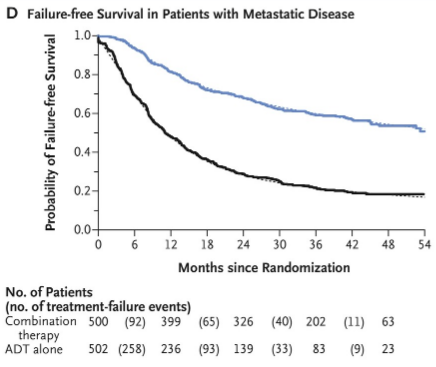


Let’s look at that black line first.  This is the control group that only received Lupron (ADT).  It tells you all you need to know about median times and how response to treatment varies greatly from individual to individual.  According to this graph, the median time before Lupron fails is about 12 months.  12 months?!?  What chance does anybody have to make it to 5 years?  Actually, about a 20% chance.  Look at how that black line flattens out on the right side.

This is how cancer treatment seems to go.  You get some number of men that don’t have a great or lasting response to treatment, while others have a great response and live for a very long time.  There’s not a lot of rhyme nor reason to who responds and who doesn’t.

The blue line is for the early Zytiga group, and after almost five years the treatment is still working for half the men.

Taken together, these two graphs paint a picture of a miraculous improvement in outcomes.  Not only are men living years longer, but the number of men going well beyond the five year mark is exploding.  This is remarkable progress in the fight against cancer.  Except…

Financial Toxicity

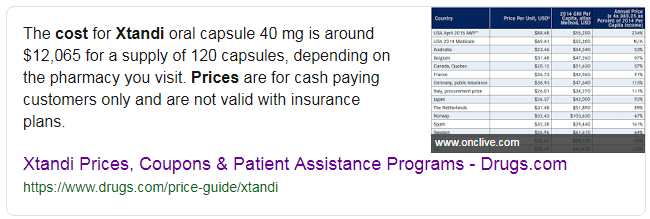
Remember when I said that Zytiga cost about $10,000 a month?  Did you notice how many men are living for 60 or more months while taking Zytiga the whole time?  Yes, you too can beat cancer for five years for the low low price of $600,000.  Oops, I forgot, you’re also on Lupron during that time as well, so that price is closer to $700,000.  If you don’t have drug coverage and live in a nice neighborhood, you could sell your house for five years of living homeless.

If you compare this to the earlier Lupron only example, you will quickly see that, approximately, survival has doubled while the lifetime cost of treatment has gone up by a factor of 10.  I'm not too terribly concerned with the exact number, but did want to point out that these better treatments cost more per month and lead to longer survival, which causes the total costs to explode.

One caveat: Zytiga became available as generic Abiraterone in late 2018 for a much lower price of about $4,000 a month.  This would make the 5-year total cost of Abiraterone and Lupron roughly $350,000.  Yay, half price!

Remember Xtandi?  That’s also roughly $10,000 a month, and no generic is available.  Just to show I'm not making this stuff up:

Another part of the Stampede trial is testing a combination of Zytiga and Xtandi.  Let me paraphrase that study: Can we add a few more years to survival by doubling the monthly cost of treatment?  If the answer is yes, treatment costs for the average patient will now run into the millions.

For now, I'm also going to ignore the issue of side effects accumulating as more medications are used in combination.  Suffice to say some people view cancer treatment as paying a lot of money to feel like crap, "but at least I'm still alive".

These prices are a double edged sword.  Pharmaceutical companies are rushing to develop newer and better cancer medicines due to the insane profits they can make.  This is driving great progress in treating cancer, but for patients, insurance companies, and medicare, it effectively turns a medical disaster into a financial disaster.  Arguing about private insurance versus medicare for all quickly becomes a debate about which one should go bankrupt.  We need to control costs without removing the incentive for innovation.

But enough politics for now.  I don't have any ready answer, just wanted to highlight the problem I see and say it can't be solved with a sound bite.

Coming up in Part 2: Bacteria, cancer cells, and why cancer can be so darn difficult to cure.

Wednesday, June 19, 2019

Day 244, 8 Month Update

Today is the 8 month anniversary of my advanced prostate cancer diagnosis.  To celebrate I went and had a root canal.  This was supposed to be part two of a two part root canal, but as there are still signs of infection there will now be a part three.  Yippee!  While I’m talking about unpleasant things, let me get moment of drama out of the way first.  I am frequently tired, in pain, and have been losing weight recently.  Normally these would be horrible signs for a cancer patient.  But…

... there’s a slight chance these are the result of a massive increase in my activity level over the past month.  I’m now approaching 30 miles a week of walking and running, which does not include other outdoor activities such as mowing the lawn or cutting up downed trees for firewood.

I began running seriously at age 40.  Since then I’ve run a total of 22 5Ks, 6 half marathons, a full marathon, and a handful of other races of odd distances.  Two of those 5Ks have been since my diagnoses, and neither has been my slowest.  In fact, my last one just over a week ago was faster than every 5K I ran at age 40.  So, at age 51 and undergoing cancer treatment, I can run faster and longer than I could when I was a new runner at age 40.

My diet is healthier too.  Recently I’ve been focused on eating more fruit and nuts, and between that and medication side effects the desire to eat less healthy foods in large quantities has waned.  Recently I’ve had to make some effort to eat more to keep my weight up, which is sort of odd.

Today I also spoke with the HR department at the office about returning to work.  I’ve been gone long enough now that I need a note from my treating physician saying that I’m fit to return to work, including the limitations I have that need to be accommodated.  Everybody seems to be in general agreement with the plan, but the paperwork might take a while.

About those limitations: my cancer has been treated very aggressively, with multiple drugs given much earlier in the disease process than would have been done only a few years ago.  This is great for overall survival, but is both costly and causes the side effects to stack up on each other.  I could take this post in a political direction, but will save that for a separate post at a different time.  There’s another soap box I want to stand on today.

I’ve probably said this before, but it seems like every cancer drug has “fatigue” and “pain” listed in the side effects.  I was quite apprehensive before starting the latest drug, fearing that it would lead to a long life of feeling tired and sore all the time.  The internet is littered with anecdotal accounts of men trying to cope with the side effects of these drugs.  Fortunately, there is an antidote: Exercise!

And here I will get out my soap box and stand on it shouting to the world about how important exercise is.  There have been many a day where I’ve woken up tired and sore, and after a five mile run found myself pain-free and energized.  The reason I’m able to do this so easily is because I’ve been running regularly for the past decade, so habit energy is enough to get me out the door and started.

Exercise is vital if you have a serious health problem such as cancer.  A healthy body is better able to withstand treatment.  Exercise stimulates the immune system, reduces pain, and improves mood through the release of beta-endorphins.  Exercise helps maintain a healthy weight and fight metabolic syndrome.  In short, exercise keeps you healthy, and scientific evidence is mounting that healthy people live longer and have better quality of life when coping with diseases such as cancer.

Many forms of exercise will work.  Running, walking, hiking, lifting weights, swimming, biking.  Just about anything that can get your pulse rate up significantly and keep it there for a while.  And now I’ll climb off the soap box.

Despite the voluminous exercise, I do still get some side effects.  Hot flashes happen regularly, and I’m frequently too cold or too hot, and it’s very difficult to find a comfortable temperature.  Pain is very well managed, but still present as a slight discomfort much of the time.  Fatigue still happens occasionally, particularly on a dreary rainy day after I may have overdone things the previous day.

These side effects come and go but are much more likely to show up in the days and weeks after visiting the oncologist and getting my shots.  It’s all somewhat unpredictable at this point, but still improving.  So while I’m planning to go back to work full time in the near future, the process does involve negotiating an accommodation for my somewhat frequent side effect days.

But in the grand scheme of things, I’d rate my quality of life right now as better than it was in the month leading up to my diagnoses. The treatment is decidedly not worse than the disease.  Things are improving further as the side effects from chemo continue to fade.  My runs are getting faster, working in the yard and the woods is slowly giving me back some upper body strength and I’ll be returning to work soon.  In short, piece by piece I’m taking back most of the normal life I had previously, and it feels awesome!

I’ve recently been inspired by dogs.  If you take a middle age dog and tell it that it has a serious disease, what do you think the dog will do?  Will it go online and obsessively search for more information on the disease and how to treat it?  Of course not!  Have you tried to work a mouse and keyboard with a paw?

It may whimper at the vet’s office for a bit, but not long after leaving it will be too busy frollicking in a puddle and generally enjoying the moment.  And that’s how I’m trying to live.  I whimper at the oncologist’s or urologist’s office, but am trying to cut back on the time I spend researching and instead spend more time frolicking.  I feel the need to go jump in a puddle.

Tuesday, June 11, 2019

Perambulating in Vermont

I didn't have the energy yesterday for an intense run, so instead I grabbed my camera and headed out to run and walk and generally try to take pictures of interesting things.  If it's not obvious, you can click on any of these pictures to see a larger version.

My journey started out on this relatively busy road.  Fun detail: The property on the left side of the road was bought by my father-in-law back in the 1960s.

On these journeys I like to play a game I call "Private or Abandoned?"  It's really simple: For each property I go by, try to determine if it is currently privately owned and maintained or abandoned.  As a warm-up exercise, here's our nearest neighbor, who hasn't been seen in years: Abandoned!

A fork in the road, let's take the one less traveled, on the right:
 

You know a road is lightly traveled when you can put your camera down on the road surface, set the timer for 10 seconds, and take a selfie without worry about getting interrupted by a passing car that might run over your camera.

Even though this area is in the foothills of the green mountains, most of the time you can't see the scenery for the trees.  But a large hay field does make for good views of the distant mountains.

Remember that first photo with the property my father in law bought back in the 1960s?  It's a long, "L" shaped property, and the back border is somewhere in the middle of this ridge line, but I don't know exactly where.  It's a long difficult hike to get back there, and the border marks have long since faded.  Property boundaries in Vermont tend to be a bit approximate, but I can safely say I think we inherited a few trees somewhere on that ridge.

More mountains, this time viewed over an apple orchard:

It's time for the next round of "Private or Abandoned?"  Pretty sure this one is abandoned.


I think this used to be the bedroom, at least it looks like a couple of cots:

And now for the final and most difficult round of "Private or Abandoned?"  Is this a private driveway?  Or an abandoned road?  No house number, no "no trespassing" signs, let's have a closer look.

No structures, tree branches down in spots and not cleaned up, looks like an abandoned running alongside a stream.


I don't think this parcel is abandoned, just odd.  Looks like a septic field with two vents and a folding metal chair that's been there for years.  I've been expecting a house to be built nearby, but that hasn't happened.  Very strange.

Mooo:

Tuesday, June 4, 2019

The Cologuard Story

When you go to bed tonight, know that somewhere high in the sky, moving swiftly in a cargo plane, is a sample of my poop.  Welcome to Cologuard, non-invasive screening for colon cancer and source of endless potty humor.

Since getting my two cancer diagnoses last October, getting tested for cancer has become a sort of hobby of mine.  There have been the regular blood tests, the always fun cystoscopy, and even a bone scan.  I decided to expand on this hobby with the addition of colon cancer screening.

Actually, my doctor made this decision.  I prefer to think of it as her belated gift to me after my 50th birthday.  The traditional gift is a colonoscopy, but I insisted there was no need to go through so much trouble on account of lil ol’ me.  So I get to try out Cologuard instead, and am very happy I don’t have to put my ailing digestive tract through colonoscopy prep right now.

You’ve probably seen Cologuard commercials on TV.  Their mascot is an anthropomorphized version of the box they mail to your house to collect the “sample”.  I’ve taken to calling it the shitbox.  It’s a bright white box with a big CG logo on the side.  If you know what it is you can spot it a mile away.  You become aware of this when the UPS driver leaves it on your front step for all the neighbors to see.

I didn’t collect my “sample” right away.  My “samples” have been a bit irregular as I was on an antibiotic for a tooth infection.  It turns out my root canal was botched and needs to be redone, which is happening tomorrow.  If it’s not one thing it’s another, but I digress.

After the antibiotics were done, I started my next cancer drug.  That also affected my “samples” initially, so more delays.  During this time I got repeated calls and even something in the mail reminding me to collect my sample.  Great, now I’m getting nagged by an anthropomorphic shitbox.


There’s a surprising large instruction book that guides you through the process step by step.  I read the process of unpacking the kit and getting everything ready with increasing interest.  Each step had several illustrations accompanying it.  With increasing suspense I wondered, would there be an illustration for the, ahem, “collection” step?  How graphic would it be?  Not very graphic actually, but I still giggled with adolescent delight at an illustration of somebody having a poo.


Okay, so now that I’ve had my morning “sample”, it’s time to ship it back for testing.  I looked up UPS drop off points on the interweb, and was shocked to find out it could be taken at the local hardware store.  Umm.  I’m going to have to say “no” to walking into a hardware store holding a box with a giant CG logo on it.  Not too much further away is a genuine UPS customer center.  Let’s go there instead.

Sadly I forgot my trench coat and dark sunglasses, mostly because I don’t own a trench coat.  Instead I just put the box under my arm, with the arm over the side with the big logo on it., and tried not to make eye contact while walking through the parking lot.  I guess I’m a bit self conscious about carrying a box with my “sample” in public, but not so shy about describing the whole thing on the interweb.  Go figure.

And that’s my Cologuard story.  I’m now anxiously awaiting the results, as I anxiously awaited many of the cancer related tests that have been done over the past 7 months.  I tend to be in one of three states of mind lately.

State of mind 1 is the most expected.  It worries about test results, and thinks about how bad a negative result would be.  This is a flawed approach.  It assumes that the disease doesn’t exist until the test finds it, so if you don’t get the test you won’t get the disease.  I’m sure it led to some procrastination in my initial diagnoses, which didn’t help the situation.

State of mind 2 is sort of a disinterested zen state.  This is an improvement over State 1, and is arguably the best state to be in.  A positive Cologuard result just means I have to go and get a colonoscopy anyway.  If that finds something, hopefully it will be early enough for a quick and full cure.  It’s very detached emotionally and focuses on solving the problem at hand.  Frankly, it would rather be out running or hiking or playing a video game.

I was in my disinterested zen state today and noticed that the light of the setting sun highlighted the ridges on my thumbnail.  Not the normal lengthwise ridges, but the crosswise ones caused by the changing speed of nail growth during chemo.  Each ridge represents a chemo cycle, sort of like growth rings in a tree.  There’s quite a bit of nail without ridges now, showing the time I’ve been recovering from chemo.


State of mind 3 is by far the most fun.  It’s my super-hero alter ego, Obstinate Man, and lately includes extreme bravado.  I brag about my cancers.  How I got two diagnoses in a month, and now one has been removed entirely and the other is on the way to complete remission.  How I ran throughout chemo and am now taking a minute a mile off my pace every two weeks.  It’s probably insufferable to listen to but it gives me the aura of control.  “Do you want to come at me with a third cancer?  Bring it on, bitch!”  Obstinate Man is starting to sound a bit like Jessie from “Breaking Bad”.

As I wrap this up, I see a vapor trail moving across the sky, brightly lit by the setting sun while everything around is in shadow.  I wonder if there’s a bit of me on that plane.

Monday, May 20, 2019

Day 214, I Want a New Drug

I Want a New Drug
In my previous blog entry, which turned into a creative writing exercise, I hopefully painted a picture of rapid improvement in my condition mixed with some fear of the side effects of the next drug in my treatment.  I started that new drug just a few hours after that blog post.  It seems my fears of the side effects were not unfounded.

This is not any ordinary pharmaceutical.  It’s not something they keep on hand at the local CVS.  Instead, it’s handled by a specialty pharmacy (in this case, CVS specialty) which then ships the drug to a normal CVS for pickup.  It could be shipped directly to my home, but I’d worry about the local wildlife getting into the package while we’re away.

Before it would ship, I had to talk on the phone with the specialty pharmacy and answer a bunch of questions, then there was the mandatory consultation with a specialty pharmacist who admitted it’s hard to have any meaningful questions until I’ve actually taken the drug.  So we talked about the finer points of how to take pills on an empty stomach to fill some time and then my medication was sent on its way.

There was a bit more paperwork and a surprising number of handouts at the actual pickup.  The specialty prescriptions were waiting on the tippy top shelf in humble brown bags, versus the white bags used for normal drugs.  Inside the brown paper bag was a rather frightening plastic bag.


Looks like this ain’t yo momma’s aspirin!  I was somewhat surprised by the use of the term “chemotherapy drug”, because it’s not the cytotoxic, kill everything that grows type of drug normally associated with chemotherapy.  In this case, it seems to mean “prescribed by an oncologist”.

Safety precautions aren’t that severe.  The actual tablets shouldn’t be handled by children or pregnant mothers, because.. well I’m not sure actually, but it seems to make sense that you want to keep anything that mucks about with hormone levels far away from growing bodies.

And what this drug does do is muck with a specific enzyme that performs one of the steps in making testosterone, and who knows what other hormones are being suppressed as a result.  It does suppress some of the normal stress hormones such as cortisol, so I also have a prescription for a low dose of prednisone which acts like cortisol and serves to replace the suppressed hormone.

With all the hormonal mucking about, it’s not terribly surprising that in the days after starting this new drug I went from feeling strange to totally exhausted and depressed a few days later.  “Depressed” isn’t quite the right word, as it implies laying listlessly on a couch.  What actually happened was an emotional breakdown that consumed a rather surprising number of tissues.

My emotions are about as hormonal as it’s possible to get.  In a strange way that’s good news, as the drug is doing exactly what it was prescribed to do.  To make things even more fun, my occasional hot flashes have gotten more intense.  Now instead of being uncomfortably hot a number of times a day, I get uncomfortably hot and sweat profusely.  This is mostly just an annoyance until it starts waking me from my sleep.

The good news is I may have hit bottom over the weekend and have been improving since.  It’s hard to say for sure, because before any of this started I was already a bit cyclical in my moods.  Sort of like being manic depressive, but not to the extent that I’d be diagnosed as such.  So it’s really hard to say if my bad couple of days were caused by starting the drug or were just the usual two steps back after a very impressive three steps forward in the preceding weeks.  Most likely it’s a combination of starting the drug at the exact moment I was due for a crash anyway.

Time for a quick musical intermission:

During this low period, there’s been lots of angst and worry by me about whether I’d be able to stay on this drug or not.  After having had a decent run this morning (that’s a bit of understatement), I’m feeling much better and will just stay the current course until I meet with my oncologist a week and a half from now.  That would be an appropriate time to review how I’m responding to the drug (including blood tests to check liver function) and discuss whether a dosage adjustment to either the drug itself or the prednisone makes sense.

About that run: I’ve been making an effort to increase the length of my runs recently, and set another high water mark today of 6.8 miles in just over 90 minutes.  That kind of pace isn’t going to set my hair on fire but not that long ago I was struggling to do less than half that distance in more than half the time.  If it didn’t feel quite as great as some of my other recent runs, that probably has a lot to do with the slightly warmer and much more humid weather we’re having today.

So in summary, my new drug is currently playing head games with me, but in the objective world of time and distance, my running isn’t showing any noticeable effect.  I haven’t even been on it for a week yet so it’s time to chill a bit and see where things are at the end of the month.

P.S. It’s really awesome that this post was entirely about side effects and not a word about the cancer itself.  Many men end up on this drug because other drugs stop working.  In my case it’s hopefully going to deliver a knockout punch.

P.S. 2 “The drug” is Abiraterone, it’s just easier to type “the drug”.  It’s also fun watching the non-pharmacists working the counter at CVS try to read it off their computer screens.

Tuesday, May 14, 2019

Day 208, Inspired by Kurt Vonnegut

For the better part of a week I’ve been trying to write the ultimate blog post.  There were high expectations that it would bring hope to fellow cancer patients, inspire those without cancer, and generally make the world a better place.  To maximize my creativity, I eschewed the computer in favor of writing a draft by hand by candlelight.  Unfortunately, I gave that draft to fellow writer Kilgore Trout to get his thoughts on how it could be improved even further, and he lost it.

   *   *   *

The draft went into exquisite detail about medical technology and what it can and can’t do with regards to assessing the state of cancer.  There was a beautiful long narrative about the journey of radioactive tracer from the veins, to the bones, and finally through the kidney and into the bladder.  You should have seen my new bone scan, with it’s bright bladder full of tracer that outshined even the brightest of tumors.  Of course, those tumors may now in fact be dead or dormant and what is showing up on the scan could be bone healing.

There was a very funny passage about how dormant cancer is just like dead cancer, except that dormant cancer could wake up at any time.  Treatment continues to keep the cancer dormant with the hope that it will die peacefully in its sleep.  There were comparisons made between me and supervillains that keep their foes alive so that they might have a slow painful death.  I had re-watched “Austin Powers” several times to get every nuance about what Scotty Evil said about the expediency of immediately shooting your adversary, but sadly that quote is now lost.

So while there’s very little evidence for any active cancer, treatment is ongoing to keep it away.  This cancer thing is taking longer than I expected.

   *   *   *

I went to great lengths to discuss the numerous intricacies of being on disability leave from work.  How I’ve had huge improvements in the last couple weeks as my recovery from chemo picks up speed.  For months I’ve had the idea in the back of my head that this summer would be a good time to get back to the office.  There’s still a few hurdles to overcome, but at the moment it’s a good possibility.

In one of my more inspired sections, I had plotted my return to work as if it was an engineering project.  Unfortunately all my Gannt charts and Scrum stories were lost with the draft.  Gantt charts aren’t normally part of Scrum, but I had combined parts of waterfall and agile methodologies into a new process that would have revolutionized software development.

In any event, there is an extra incentive to get back to the office before October.  To continue on disability leave past then would require applying for social security disability.  Apparently they would want specific explanations as to why I am unable to work, and honestly, I think it’s counterproductive to my recovery to focus on my limitations.  If I applied today, it would likely be written as a series of haikus.

Cancer causes more paperwork than I expected.

   *   *   *

The lost draft was 600 pages long, if you’re curious.  Shorter than any Game of Thrones novel.  I like to keep things concise.

   *   *   *

I do still have the graph from my Garmin showing how much I’ve run in each month for the past year.  Shockingly, the shape very closely follows how I’ve felt for the past year.  I just might be crazy enough to use running mileage as a metric for my recovery.


Note the fall in mileage starting in August until my diagnosis in October.  At the time I thought it was an overuse injury, but in retrospect it was actually symptoms of advancing cancer.  While it may seem that I'm running a lot, it's not even half of what I used to do while working full time.  Any running just gets a lot more publicity now because of the cancer and chemotherapy things.

   *   *   *

My cell phone rang just now and it was the pharmacy calling to let me know my abiraterone acetate is in.  This is a second line hormonal agent that will drive the cancer into a deeper state of dormancy, and hopefully cause even more to die in their sleep.  I hope it gives them nightmares too.

True story:  Years ago I dabbled in teaching myself to play the guitar without much success.  Recently I’ve started that up again.  I wrote a song about my treatment.  Each verse covered a different drug, from leuprolide to docetaxel to abiraterone acetate, and then the chorus lamented that they all had the same side effects of joint pain and fatigue.  The bridge leading into the guitar solo mentioned some other pharmaceuticals that can help offset the side effects.

The reader might want to ask themselves if “true story” applies to the entire paragraph above, or just the first sentence or two.

This should be the last medication change for a very long time, finally.  My return to work has taken so long because just as I start to feel ready to return, the next treatment is on the horizon and I don’t know how it will affect me.  I’m hopeful this one will be a non-event.

This cancer thing involves more drugs than I expected.

   *   *   *

What wasn’t in the lost draft was the tale of my root canal gone bad.  I had dental pain early last year that resulted in a root canal.  Unfortunately the endodontist who did it missed one of the canals, so it’s since gotten re-infected.  I find the timing suspicious as it seems to have happened when my immune system was compromised due to chemo.

I’ve gone from pain and digestive issues due to chemo to dental pain and digestive issues due to antibiotics.  This cancer thing has more twists and turns and ups and downs than I expected.

   *   *   *

The best way to offset fatigue from all those cancer drugs, counterintuitively, is exercise.  My original draft included detailed descriptions of some very aerobic celebratory dances that can be done when you receive good news such as finding out that the promising but rather expensive cancer drug will be covered by your health insurance, even though your oncologist is prescribing it sooner than usual.

I’ve been trying to continue my explorations of the Midstate Trail, but all the recent rains have left the trail muddy and wet.  I did get out to the section that goes up and over Wachusett mountain recently.  It’s the steepest and rockiest terrain I’ve tried to cross since diagnosis, and while I was pleased to have the dexterity and endurance needed, it was causing havoc with my sciatic nerve.  Discretion being the better part of valor, I turned around short of the summit so that I’d be able to get back down the mountain and drive home without excessive discomfort.

At one point, the trail was so muddy it could have used a bridge over the mud and puddles to get to a bridge over the stream.


This rainy weather is taking longer than I expected.  Bonus photo:


I was pretty tired and grumpy after my hike.  While exercise helps with fatigue, it’s neither miraculous nor instant.  However, I’m only a little over a month past the end of chemo, and most of the improvement I’ve seen has been all in the last two weeks.

If it weren’t for the addition of yet another drug to my regimen, I’d be quite optimistic about getting back most of my old energy in the not too distant future.  Another drug is another unknown so we’ll just have to wait and see.

   *   *   *

The part of the lost draft that I miss the most was the ending.  It was very thankful of my employer, my coworkers and managers, and how supportive they’ve been.  Having great medical and disability coverage has removed any worry about cancer causing financial problems.  This cancer thing is more expensive than I expected.

Having time away from work has also allowed me to focus on fighting and recovering from the battles.  Scientific studies have shown that the best way to fight prostate cancer is to hit it as hard as possible as soon as possible.  The downside is that there are a lot of treatment side effects to deal with.  The upside, hopefully, is better control of the disease and better quality of life later on.

My simplistic way of looking at the situation is that I had a lot of cancer in my bones which was causing rapidly increasing amounts of pain last October.  Aggressive treatment is the best way to get it out of the bones and get rid of the source of the pain.  However, cancer dying in your bones isn’t any less painful than cancer living in your bones.  Once it’s dead or gone dormant, then the bones and nerves can begin healing.  I had a noticeable reduction in pain last November, just before chemo, but it’s only been in the past few weeks that I’ve had another significant reduction in pain and improvement in my ability to do things.

To put it in terms of running, not long ago I was struggling to walk (with occasional bits of running thrown in) more than 3 miles, and as often as not exercise would bring the chemo side effects to the forefront.  Most days I’d only have a few good hours to do things, and those hours were usually taken up with medical appointments.

Suddenly I’m running (with regular walk breaks) 5 miles and chemo side effects are being replaced with a runner’s high.  I’m good for over half a day, though can’t regularly handle being busy for most the day (see my Wachusett failure and its grumpy aftermath, above).  If I weren’t adding another drug, I’d fully expect to be up to 8+ miles and ready to work full time in a month or so.

I’m having a great response to treatment, and all signs point to eventually achieving a lasting remission.  This might even include going off all treatment entirely some day.  Being off treatment with no signs of disease is only slightly more likely than winning the lottery, but it does happen and so far I’m liking my odds.  It makes dealing with the aggressive treatment much easier.

This cancer thing makes a better story than I expected.