Thursday, September 19, 2019

Hamster Power and Cancer Awareness

“Mummie… Mummie… MUMMIE!!!”
“Sigh… what is it Timmy?”
“Mummie, why is that strange man running uphill shouting ‘Hamster Power’?”
“I don’t know, just keep a safe distance”

Timmy’s quandary will be resolved by the end of this post, but first, September is prostate cancer awareness month, and OMG, I can’t believe it’s already been 11 months since my diagnosis.  Suffice to say I’m doing much better than the unlucky minority that don’t survive their first year past diagnosis.

Generally I’m doing exceptionally well, with a couple notable footnotes.  First and most annoyingly, my hot flashes are getting worse, and starting to interfere with things such as sleep.  I’m either uncomfortably cool, or hot and sweaty, and seem to be losing the ability to spend any time feeling pleasantly warm.  It’s a problem to be solved, but so far I haven’t found a simple solution.

The other footnote is that my blood pressure seems to be inching up.  This is a very common side effect of my medication, and it’s something to keep an eye on.  It’s also a great example of something that for most people changes slowly over years if not decades, but when you’re battling cancer these changes can happen in just a couple months.

Most of this is due to treatment to suppress testosterone, and not the disease itself.  Let me try to explain how prostate cancer treatment feels.  Imagine for a moment you’re a healthy and relatively young man.  You think about sex frequently.  You’re active and loud and brash, sort of like this:


Tommy Shaw is an excellent guitarist, but Ted Nugent is on a whole different level.  Anyhow, now imagine that you find yourself in middle age and without testosterone.  Sex is no longer a pre-occupation.  You feel more sedate somehow.  You’re still upbeat and enjoy smiling, but it all somehow seems a bit weird, and like your body is speaking an entirely different language:

Prostate Cancer Awareness

Semen.  Specifically, semen with a slight pink tint.  That was the first sign that something was not right in my body.  I had a PSA screening test about six, maybe eight months earlier that came back at 2.0, completely normal.  Prostate cancer is a slow growing cancer and with a low PSA this couldn’t be cancer.  Must be an infection.  This symptom didn’t repeat itself so the infection must have cleared up and I went on with life.

A few months later, the start of my urine stream had a slight brown tint to it.  I wouldn’t have noticed except that the first drops landing in the urinal looked different.  Gonna have to keep an eye on that.  Oh look, it went away for weeks.  Now it’s back again.  Sigh.  I looked up urologists on Google, but the ones I found on my first try seemed to be vasectomy factories.

Eventually, I found a urologist near the office that had good reviews and made an appointment.  Around this time, that niggling running injury turned into back pain that made sitting very uncomfortable.  On Friday whenI had my appointment, I got the dreaded DRE.  “Digital Rectal Exam”.  This is the reason why men sometimes seek out women urologists for their generally smaller fingers.  I had a nodule on the right side of my prostate, better get some blood and schedule a CT scan.

To make a long story short, my PSA had gone from a happy 2.0 to a “worrisome” 216 in 13 months.  The CT scan and a subsequent bone scan showed widespread metastases.  The biopsy report indicated “intraductal carcinoma”, which is a rare form that is very aggressive and doesn’t output much PSA, and thus tends to avoid the screening test until it’s way too late for a cure.

A quick word about survival statistics: They apply to populations and not individual patients.  Prostate cancer has about a 90% five year survival rate.  But, 90% of prostate cancers are caught when removing the prostate is curative, and the five year survival for those cases approaches 100%.  It’s the unlucky 10% like me that have advanced disease at diagnosis that account for nearly all the deaths within five years of diagnosis.

My personal message to you is not a simple “get screened and everything will be okay”.  Screening is important, but the PSA test is far from infallible, and failed me miserably.  You must also be on the lookout for symptoms that indicate something is wrong and further investigation is warranted.  Back aches are a plague of middle age, but they can also be a symptom of metastasized cancer.

The other part of my message is to be aware that tomorrow is not guaranteed.  Screening tests aren’t perfect, and neither are doctors.  A careful balancing act is required here.  It is wise to get screened for cancer and be aware of symptoms that aren’t right, but on the other hand you can’t live your life worrying that every ache and pain is a potentially fatal symptom.

It’s something I still grapple with.  I just finished telling you about how I ignored the early symptoms of my cancer.  Do I wish I went to the urologist sooner?  Definitely.  Would it have made a significant difference in my diagnosis?  Probably not.  There would have been the advantage of starting treatment sooner, and I may have been able to skip the radiation treatment to my spine, but that’s about it.  I’m convinced my cancer was widespread before I had any symptoms.

Let’s go back to those survival statistics one more time.  Have you seen the long term survival rates for prostate cancer?  Virtually nobody with my diagnosis is reaching the age of 100.  Despite all the millions spent on research, death continues to be our number one killer, and I’ve reached the limit of how much cancer awareness I can write about without getting silly.

Hamster Power

It was finally the day.  I went out the door and ran and walked my way through two states, four towns, 650 feet of elevation change, and covered 12.7 miles.  It was my longest run in over three years, and it felt great, at least for those of us that enjoy sore feet, aching muscles, and heavy breathing.

This was only four days after getting injected with “hamster juice”, which is my new term of endearment for Xgeva, the bone strengthener produced in genetically engineered hamster ovaries.  Hamster juice is intended to help my bones heal from the damage caused by the cancer, and is what allows me to continue running.  Of course, the running further strengthens the bones, so it’s a very synergistic combination.

In a way, it’s a bit silly to push my running to the next level while the side effects of a hamster juice injection are at their peak.  On the other hand, I’m finding that getting out and moving while the body is under duress due to other issues eventually leads to bigger gains in fitness.  I honestly was pushing through the joint pain and fatigue by shouting “Hamster Power!”, but of course my vocal cords wheren’t engaged, so it was a whispered shout.

This route starts with a long uphill stretch, with a payoff at the top of the hill.  There are several horse farms with pastures that provide a view of hills and mountains way off in the distance.  At one farm they were setting up folding chairs for what looked to be an impending outdoor wedding with a view.  It’s just one of the ways that you can run the same route repeatedly, and it’s a little different each time.  It’s why I enjoy running outdoors instead of on a treadmill.

From the view it goes downhill for the next mile and into New Hampshire.  I skipped a walk break or two and glided down the hill to gain back some of the time lost on the uphill section.  My toes were taking a pounding here as they repeatedly slammed into the front of my shoes.  At the bottom I stopped to tighten up the laces.  That reduced the toe pounding, but tight laces can lead to foot cramps.  Longer runs leave less room for errors in mundane things like how tight you tie your laces.  Okay, still a couple more hills to get over.

Cranking up one of the last real hills, I started thinking to myself “Keep those feet turning.  Keep moving.  Go Forward.  Move Ahead.  It’s not too late, to whip it!  Whip it good!”  Did I mention I get silly on long runs?


After the hills the road gets lumpy.  It’s never flat, there’s just an endless series of short ups and downs.  Not quite high enough to be called hills.  Not enough to get into a rhythm.  Just enough to make the route a real challenge.

At about mile 11 the endorphins really started kicking in.  I was going to finish this route for the first time in years.  Fuck the cancer.  I whisper-shouted “I FEEL AWESOME!!!”, and then sucked in a bug on the subsequent inhale.  Gag, cough!

After my free protein supplement from mother nature, it was mostly downhill back home, and nothing of importance happened.  I finished my run feeling tired and sore, but not really any more tired and sore than I would be after running a dozen miles years ago.  The problems I’m having with sore feet and inhaling bugs are running problems, not cancer problems.

A few days after that long run, I took a run/walk/hike in Vermont.  That went down an all but abandoned stretch of road, past a couple abandoned houses, and ended at a field next to what appears to be a well maintained but off the grid house.  I honestly don’t know if the field is owned by the house, or is simply part of Jamaica state forest.  But since there was nobody at the house, I “trespassed” onto the field which has one of the best mountain views in the area.

I wish I had my camera to capture the view.  However, the lack of a camera didn’t stop me from posing for a few photos that weren’t taken. I was really hamming it up.  I hooted and hollered, for real as there didn’t seem to be anybody around for a mile in any direction.  I was feeling great from the run, and such antics only improved my mood further.  I did handstands and cartwheels.  I used yoga powers to levitate.  Nobody was around to confirm or deny these claims.

Such silliness keeps me from dwelling on other aspects of my situation.  About the hot flashes, somewhat disturbed sleep, and increasing blood pressure.  About the unlikeliness of celebrating my 100th birthday.  About how my mom probably won’t be around for that birthday if I do reach it (who knows, maybe she will live to 130+).  For a moment, I’m just a guy enjoying the moment.

Because really, at the moment I’m doing very well, and I’ve shown a new found ability to deal with things as they come up.  When I get entirely absorbed in a run, or in a video game, or even a problem at work, it shows some ability to not worry about things that haven’t happened yet and don’t need to be dealt with until they happen.  If I can do that for a moment, perhaps I can do it for another moment.

Epilogue

The seat belt sign had just been turned off as the plane banked into a turn to head east for Europe.  Timmy gazed out the window at the tree covered mountains and hills that lay below him, and saw a field with a strange man jumping up and down on a rock.  “Mummy, there he is again!”

Saturday, September 7, 2019

The Wapack Water Stop

In this post:

  • Pain Update
  • The Wapack Water Stop
  • Baystate Training Update

Pain Update

In my previous post, I set up an epic battle between myself and that nagging pain in my back and hip which was largely blamed on too much enthusiasm in my running.  What I sort of didn't mention was that running is only a partial contributor to my condition.  I'm also cutting and splitting firewood, and lugging a chainsaw into the woods to cut a trail on our property.


All this bending and lifting and generally using a good portion of my bodily strength in odd positions also takes its toll on my joints.  Holding a chainsaw to cut fallen trees on uneven terrain is a form of backwoods yoga.  It's both a sign of my continued improvement, and also a source of pain and stiffness when I do eventually find my new, improved limits.

So take my whining with a grain of salt.  It comes from a place of pain and fatigue, and my brain isn't always good at remembering all the things I did leading up to the pain and fatigue.  Happily my wife is pretty good at remembering and reminding me how I got into such a state.

Wapack Trail Race Water Stop

Due to various life events, it's been a few years since I've been able to help out at the Wapack trail race.  For those who aren't familiar with it, it's a small but very challenging race that runs out and back on the Wapack trail over four mountain peaks.  About 18 miles in total, with nearly 4,000 ft of up hills and an equal measure of downhills.  I've never actually run the race, but I have run the whole course in shorter sections.  This year I got the call to set up the water stop in the middle of the trail.

Access to this section of the trail is very limited.  In the 9 miles between Windblown ski area and the Mount Watatic parking area, there is only one spot where it's possible to drive a vehicle right up to the trail, and that involves travelling over half a mile of gravel road that is no longer maintained.  A week before the race, I was in the area and scouted out the road.  It had some pretty significant washout:


The basic problem is that it's a narrow road and only half washed out, so one side of my truck has to ride on the portion of road that's still in reasonable condition, while the other side bounces along in the bottom of the washout.  This makes it vulnerable to any high spots in the transition between normal and washed out road.  It was still somewhat passable, but in spots I had to choose between scraping the bottom on the middle of the road, or scraping the running boards on the side of the road.  There were more heavy rains a few days before the race.  I feared further washout may have occurred.

There were two ways to deal with the situation.  One would have been to get a bunch of people together on race morning and carry the 10 gallon coolers full of water on foot up the half mile of steep gravel road.  10 gallons of water weigh about 80 lbs, plus the weight of the empty cooler.  The other way would be to assemble a few volunteers the day before the race with shovels and rakes and implements of destruction, knock down the offending high spots on the road, and use the material to fill in the worst of the low spots.  Suffice to say, we chose the option that involved implements of destruction and use of 4WD-LO.  And so it was that 30 gallons of water was delivered on time on race day to the water stop.


You can add shoveling and raking gravel as well as lifting 80 pound, 10 gallon water coolers into the truck to the list of things I'm doing and then forget about when I complain about pain.

As for the race itself, there was an exciting back and forth battle for the win between a guy who was better up the hills vs a guy who was better on the flats.  They came into the water stop together, and seemingly took a brief truce to refill their water bottles and drink some Gatorade.  That is until the guy who had been a few steps behind coming into the water stop decided to resume the race without warning, causing the previous leader to toss his partially consumed water cup and rush off in pursuit.  I found it rather amusing.  The third place runner came by a number of minutes later.

There's also an interesting anecdote about the leading woman runner.  She took her time re hydrating, and carefully placed her empty cup into the garbage can nearby.  While this was happening a male runner came by, grabbed a water cup on the run, gulped it down, and tossed it on the side of the trail.  The leading woman picked up the tossed cup off the trail and put that in the garbage while sighing something about "Boys!", before casually running off to resume her race.  I expect she went on to win ahead of all other women in the race, and she seemed like she was just having a casual morning out in the woods.

While the race went on I found myself increasingly fidgety and wanting to be in the race.  This race has been on my bucket list for years but I've never been in good enough shape to dare to enter it.  Usually, I get over-enthusiastic in my spring and early summer training, develop over-use injuries, and then put my dreams of the Wapack trail race and fall marathons on hold for another year.  It may be time to make a more determined, more deliberate attempt at this race next year.  It sort of feels like it's reached the point of now or never.

Let me describe fidgety.  When fellow club member Paul came by the water stop for the second time, we started to talk, and rather than hold him up I chose to run about a half mile with him.  Paul is not only running the race, he's also the race director.  He was helping with the road repair the day before the race, helped with race setup the morning of the race, ran all 18 miles and 4,000 feet of elevation gain of the race itself, and helped to clean up afterwards.  He's in his late 60s and I was running pretty fast to keep up with him for that half mile.  I can't wait to be almost 70 so I can have his level of energy.

After jogging back to the water stop, I then ran the same section with Chris, another fellow club member and host of the runrunlive podcast.  After the last runner had gone by, I ran the same section a third time to retrieve a length of yellow "CAUTION" tape we had previously strung up at a fork in the trail to prevent runners from going the wrong way.  In all, my step counter claims I covered several miles working a stationary water stop.

One final anecdote from the race:  One runner came into the water stop with his jaw hanging open in surprise.  How did we get the truck up here?  he asked, after introducing himself as the director of the spring Wapack and Back race.  "Magic" I said, and then went on to tell him about the crew with implements of destruction that was working the previous day.  It seems the spring race chose the option to carry water in on foot.  He was very thankful that they might not have to do that again next year.

After all the runners had gone by, we broke down the water stop and drove to the finish line to partake in pizza and snacks while watching the runners come in.  I had hoped to help with the post race cleanup, but my body had other ideas.  After hours of boundless energy and enthusiasm, I was reminded that my last chemotherapy infusion was less than six months ago.  There is an emerging pattern that if I go well beyond my limits, I will still get what feels like chemo side effects.  So I left before all the runners had finished to go home and lay down for a few hours.

Baystate Training Update

After a few hours of laying down, I felt well enough to get out and go for a six mile run.  As mentioned previously, I signed up to run the Baystate half marathon on October 20th to celebrate the first anniversary of my cancer diagnoses.  All indications are that I will crush this race, but it's likely I'll be taking a nap afterwards.  Not too shabby considering all I've been through in the past year.

Yesterday I woke up at 6am, and was out the door at 7:15 for a 10 mile run and couldn't dilly dally because I had to be back home and cleaned up in time to dial in to a 10am meeting.  (side note: If you're over the age of 50, you can refer to video conferencing as "dialing in", because I am old enough to remember and have used a rotary dial phone).  This was sort of a dry run for race day where I'll have to be up early, drive myself to Lowell, and be ready to race at 8am.  Waking up and running weren't a problem, but there may be some digestive issues I'll need to address.

After my previous post, I expected to have to cut back on my running pace and mileage and focus on strength training exercises for a few weeks.  In reality, I did cut back my pace and mileage for about a week, and did my strengthening exercises once, maybe twice.  After that, I went out and ran 33 miles in a week, which also including some time spent working in the woods with a chainsaw.

Let's put that in perspective.  Prior to this year, I hadn't run 30 miles in a week since 2015.  I've had seven 30-mile weeks so far in 2019.  I have to go all the way back to 2013 to find a week where I ran more than 33 miles in a week.  When I talk about running the Wapack trail race and marathons in the not too distant future, it's not a pipe dream or bluster.  It's simply looking at my current running performances and assuming I'll continue to improve if I keep training and avoid injury.

I'm running better than I have in years.  My Garmin is producing hard data to back that up.  The fact that I'm doing this while continuing to put all sorts of chemicals into my body to fight cancer just blows my mind.  I'm as curious as anybody to see how far and how fast my body can eventually go.

Saturday, August 24, 2019

Tom vs "The Pain"

For those that have been following my story and were left hanging by my previous post, my cystoscopy went well and once again my bladder checked out all clear.  This means I get to go until early October without a doctor looking for problems.  Treatments continue to work and it's time to continue to go about the business of living life.

This is actually very difficult to do.  In mathematical terms, "Cancer Diagnosis" + "Internet Access" = "Paranoid Hypochondriac".  Every little ache and pain must be the cancer coming back... I must do everything to fight my disease... I'd eat a tree if it would cure me...  I should be spending each waking moment figuring out which tree to eat to fight cancer. (side note: the chemo I received was a synthetic version of a compound from a yew tree) And then an epiphany occurred.

Avoiding death is no way to live a life.  Setting goals, exploring one's limits, growing as a person, helping others, loving, laughing, crying.  That's what life is all about.

So far I've tried to be audacious in my goal setting.  Get my PSA to undetectable, check!  Run a 30 minute 5K, check!  Hmm, those weren't nearly as hard as I imagined.  In an attempt to be even more audacious, I recently signed up for the Baystate half marathon on October 20th.

Ten years ago Baystate was my first ever half marathon.  October 20th will be a year and a day after my diagnosis.  What better way to celebrate a year of surviving cancer than to retrace my steps as a new runner a decade ago?

In the time since first thinking of a fall half marathon, it's gone from seeming challenging, to being a slam dunk, and back to being a challenge.  It all has to do with how my body is feeling from week to week, and right now I have "the pain".

The pain is my frequently sore sacroiliac joint.  It's also an area that still showed activity on my latest bone scan.  Could be cancer, could be overuse and arthritis (which could show up in a bone scan), or maybe some combination of both.  There's no way to say for sure without a biopsy.  In the meantime, the formula is now "Cancer Diagnosis" + "Internet Access" + "Non-specific symptoms" = "Anxiety" + "Paranoid Hypochondriac".

To provide some perspective, the only time in the past year when I've been completely free of "the pain" was about a two week window around the end of June.  This also corresponds to a time when I went six weeks between bone strengthening shots that are normally given every four weeks.  Hmmm.  This is also a very common problem in runners, and given the mileage I've been running it's somewhat amazing that a known weak spot hasn't been giving me more trouble.

The reasonable thing to do would be to take my running down a notch and focus on strengthening the muscles that support the joint.  Fewer miles, slower pace, and some key body weight exercises.  That would be the reasonable thing.  So of course when "the pain" was near its peak I went out and ran another 5K.  In deference to the pain, I didn't give it a 100% effort and still ended up with my second fastest 5K this year, and still faster than any I ran at age 40.  I'm not exactly debilitated by the pain.

Since that 5K, I have been a bit better about sticking to the run less and strengthen more plan, and so far results are encouraging.  I'm much more comfortable today.  Also interesting is that the humidity is lower today and it's now been two weeks since my most recent bone shot (for my regular readers, this is the substance made in genetically engineered hamster ovaries).

So I'm still well on track to pull off a half marathon in October, but my A goal of beating my time from 10 years ago is in jeopardy.  Of course, it being an A goal means it should be difficult to achieve.  I also have B and C goals, which still seem reasonable.

Of course, if I still have the pain in another six weeks at my next oncology appointment, I will mention it, and most likely he will consider my blood work and my running mileage and not order any scans or biopsies to investigate further (assuming said blood work doesn't have any evidence to support my paranoia).  My pain and paranoia has so far been an extremely poor predictor of the state of my cancer.

Beyond that, my body is still changing.  I'm probably still recovering from chemo and radiation, and still adjusting to the lack of hormones.  Hot flashes have picked up in intensity since returning to work, and that's probably due to a combination of hotter weather and an increase in caffeine intake.  My hair is growing back with newfound curliness and more unmanageable than ever.  I'm still losing weight and what muscles I did have are being covered by a layer of fat.  Through all of this, people regularly come up to me and say something along the lines of "wow, you look amazingly healthy, I heard that you're cured".

Nope, not cured.  Still on treatment to suppress testosterone and that is continuing to work by all objective measures.  In the grand scheme of things I am doing amazingly well and am very thankful and happy to be alive and enjoying life.  Life is good!  That doesn't mean I'm not dealing with some profound changes in my body and in my mind, and also the anxieties and paranoia that seem to affect all cancer patients.

But still, life is good, and I'm going to run another half marathon!  Continuing to retrace my steps as a younger runner would lead to running the Boston marathon in 2021.  I could run for charity!  Raising money for charity scares me more than running the marathon.  Hey look, an audacious goal that requires personal growth to reach!  This is living life!

Thursday, August 8, 2019

Day 294, Victories and Panic

First a large bit of good news.  I've been doing very well and have had a series of victories in the form of returning to work, taking part occasionally in a local weekly 5K series, and generally living what feels like a normal life.  In recent weeks, advanced cancer has been little more than a nuisance and a good reason not to neglect my exercise and rest.

From all I've read online, life with cancer isn't supposed to be this way.  Many people report that it took them a full year to recover from the effects of chemotherapy.  Anti-androgen therapy for prostate cancer leaves many men severely fatigued and with muscle wastage, various aches and pains, and osteoporosis.  I do experience some of those effects, but..

...my running performances have shown that once the adrenaline and endorphins get flowing, all those symptoms fade into the background.  I'm running better now than I did at any time in 2018, and I'm starting eclipse running performances going back five years.  My 5Ks are not leisurely jogs where I'm just happy to be alive and finishing.  I'm going as hard as I can with my lungs burning, my legs aching, my heart trying to jump out of my chest, and yet I still have something left for a spirited sprint to the finish, especially if there's another runner ahead I can pass at the finish.


In my last outing I finished 98 out of 202 runners overall.  Let me clarify that this was at a weekly race series in Massachusetts.  Being the home of the Boston Marathon, Massachusetts is a very competitive area to be running in.  Many local runners use small local races like this as a way to work some speed work into their marathon training.  I just finished midpack in a field of serious local runners, and I'm going to go out on a limb and guess most haven't had any surgery, radiation, chemotherapy, or androgen suppression therapy in the past year, let alone all four.

Yes I'm damn cocky and bragging all I can about it.  In an online cancer forum some have even described me as hyper-optimistic.  I'm slowly and intentionally trying to change this bluster and bragging into a message that a serious cancer diagnosis does not necessarily mean life as you knew it is over.  There will be necessary changes, but it is possible that treatment will work and you can do many of the same things you used to do.  I am a living example of cancer treatment success.  Except...

... there is that matter of my "bonus cancer".  While my very life is most threatened by metastasized prostate cancer, and it's deservedly been the focus of much of my treatments and writings, it is also true that I was also diagnosed with bladder cancer.  Bladder cancer was the reason I had surgery which led to a week of hell with a catheter and urinary retention.

Later today I'll be going to the urologist for my nine month follow-up check to see if the bladder cancer has come back, and frankly, I'm in a total panic.  Now that my prostate cancer is under control, it's like I woke up this week and realized "oh shit! I have bladder cancer!"  The bladder cancer is not any immediate and direct threat to my life, but a recurrence could certainly derail the happy train I've been riding for the past several months.

So I finally did some long overdue research into bladder cancer, and found that there is a roughly 50% chance it will come back within 5 years, and as is usually the case with cancers, many of those recurrences happen within the first year.  The interesting thing is that if it does come back, then it's very likely to come back again, and again, and again, just like what happened with my dad.  It turns out he wasn't quite the statistical outlier we thought he was.

I'm trying my best to focus on the more likely possibility that I'll get a clean report, and that in turn will mean an increased likelihood that it will never come back.  Interestingly, there is reason to believe that the systemic treatments for the prostate cancer may also keep the bladder cancer away, but of course there's never been any clinical study of the sort.  For better or worse, medical science likes to focus on individual cancers.


Yet it's so very hard not to think of what a recurrence would mean:  Another surgery.  Another insult to my body that it has to recover from.  Possibly another week with a catheter.  A very increased chance that this will become a routine problem happening every 6-12 months.  While prostate cancer threatens my life, the bladder cancer threatens my lifestyle, and that is actually the scarier prospect.  It would take the narrative I've been building and rip that to shreds.

Today is not just another day.  In a little over 6 hours I'll know if my bladder is clear and I can go back to the mostly normal life I've fought so hard to reclaim.  It's analogous to waiting to find out if you've been accepted to that elite college, or whether you'll get an offer for that dream job you just interviewed for.  It's a day that will have profound implications for my life going forward, and as a cancer patient these days happen several times a year.

A relevant observation: If I was truly living each day as if it might be my last, I wouldn't be going to the doctor.  Seeking medical treatment, and in particular going to appointments where the whole purpose of the visit is to go looking for problems, implies an assumption that there will be a number of tomorrows.  The fact that I'm suddenly so worried about bladder cancer recurrence, whereas the previous checks were mostly footnotes, actually means that prostate cancer treatment is going very well.

Two odd thoughts in closing:  I could have waited to post this until after I knew the answer, but from a story telling standpoint the drama of not knowing feels far more interesting.  Also, I really have to synchronize my urology and oncology appointments so that my routine checks are close together in a sort of "finals week".  It's more efficient to panic about two things at the same time.

Saturday, July 20, 2019

Day 275, Nine Month Update

It’s now been nine months since my diagnoses, and I’ve returned to my job of writing embedded computer software full time(*).  After almost nine months of disability leave, it felt like being reborn, and I’m very happy to rejoin the labor force (puns intended).  Overall, I’m feeling better than I have in years(*).  I’ll explain those asterisks in a few paragraphs.

One thing I’d like to clarify is that my return to work does not mean I’m cured.  I still have cancer and the plan is to continue treatment indefinitely.  While my cancer is considered incurable with current treatments, there are multiple stories on the internet of men who have responded to treatment for years and watched as their scans gradually improved over time.

My treatment is primarily centered around suppressing the testosterone that signals the cancer to grow.  In this regard I’m much like a middle aged dog that’s been fixed.  I spend a fair amount of time sleeping around the house, but still take great delight in occasionally chasing the cat around the house.  I have also been known to chase cars when out on a run (and that’s the truth!)

So about those asterisks.  Ongoing treatment brings about ongoing side effects.  The worst side effect is fatigue, but that’s mostly controlled through a combination of exercise, an antidepressant, and making sure I take time to rest.  I’m working full time but spend a couple days a week working from home.  That’s been a very effective strategy as I’m quite functional most of the time but still have the occasional day where my body just decides to quit on me.  It’s much easier to insert a nap into a workday when working at home, and I avoid the extra drain of a lengthy commute.

And that second asterisk is about having realistic expectations.  My disease didn’t appear overnight, and has probably been secretly growing and spreading through my body for years (and evading the PSA screening tests I did have, yikes!).  That means that last summer I was living with undiagnosed and untreated advanced cancer and didn’t know it.  My expectation at the time was that I was a healthy 50 year old.  I couldn’t explain why I had frequent migraines, fatigue, back pain, and generally couldn’t be bothered with attempting to engage in social activities.  In retrospect, I was trying to live a normal life with a sick body, and that became increasingly difficult.

Cancer sucks.  You really don’t want to have cancer.  If you are unfortunate enough to develop cancer, a cancer diagnosis is actually the greatest thing in the world.  It allows the disease to be treated, and once you know what you’re dealing with you can set expectations accordingly.  It’s much easier to live with diagnosed cancer that’s responding to treatment than it is to live with undiagnosed disease and trying to pretend nothing is wrong.  When people are amazed that I’m still running, I want to say “you should be more amazed that I was running at all a year ago”.

So I find myself in the rather pleasant position of seeing my health improving combined with realistic expectations of what I’m capable of.  Contrast that to last summer when my health was deteriorating rapidly and I’d fail to meet a series of lower and lower expectations.  That in a nutshell is why I’m feeling so great these days.

I’m also very thankful for all the advances that have occurred in the past decade.  Two of the major drugs I’m currently on were approved in the past 10 years.  Modern video conferencing technology allows me to attend work meetings anywhere my laptop has an internet connection.  It’s also very fortunate I chose a career where a laptop allows me to be productive at almost any time and place.  And let’s not forget the company I work for which has great health insurance and disability coverage.

I had my most recent visit with my oncologist just over a week ago, and my blood tests still look fantastic overall.  I probably won’t have another blood test until October.  That’s a huge change from having weekly tests during chemotherapy, and marks the transition from intensive treatment back to a new normal life.  “New normal” takes into account ongoing treatment along with regular tests that can provoke extreme anxiety.

Allow me to go off on a tangent about routine testing.  Have you ever had an unexplained symptom or lump or something where you had a scan or biopsy or some other test to determine if it was cancer?  Do you remember how anxious you were waiting for the results?  When they came back negative, did you refer to it as your cancer scare?  Once you have advanced cancer, you have a cancer scare every 1-3 months for the rest of your life.  And by definition you’ve already had one or more such tests come back with very bad news.  It’s enough to cause a bit of PTSD with every follow-up test, and I’ve yet to figure out how to not worry about such things.  Suffice to say I don’t have to worry about the prostate cancer again until October.  Oh wait, I have a cystoscopy to check for recurrence of bladder cancer in August.  Crap.  Worry.  Don’t try to tell me it will all be fine.  People told me that last October and it decidedly wasn’t fine.

Gasp Gasp Pant… deep breath.  Okay.  That’s not until August, let’s go on with wrapping up this blog post.

Where was I?  Transitioning to a new normal life, yes.  I fully expect my current treatment will continue to work for years.  That’s enough time for me to do many epic things, and also time for newer, better treatments to become available.  Maybe they’ll even develop a cure, though I wouldn’t hold my breath for one.  I’m very much hoping to live long enough to use my retirement savings for retirement.  But not yet.  Obstinate man is too stubborn to let a disease tell him when it’s time to stop working.

Saturday, June 29, 2019

Politics Part 1 - Cancer and Financial Toxicity

Introduction and Healthcare Politics

One of the things I like about blogging is that it allows me to go into much more detail than a tweet or Facebook post.  We unfortunately live in a world that wants to boil everything down to a short sound bite or tweet.  “Crooked Hillary”, “Beat Cancer”, and “Medicare for all” come to mind.

I consider myself to be politically independent, but living in Massachusetts does give me a pronounced lean to the left.  As a cancer patient that owes my very life to medical treatment, you think it would be a slam dunk that I’d be all in on “socialized medicine” or “Medicare for all”, but something strange has happened.

As I began thinking and writing about my experiences and what I’ve learned, it occurred to me that our current system is doing a great job at improving the lives of cancer patients.  I began to ponder the possibility of unintended consequences, and how complex this problem really is.  It involves affordability of treatment (regardless of who is paying for it), which brings in income inequality.  The cost of education and student debt is causing a shortage of doctors.  Improving healthcare in this country will necessarily require addressing all these issues.

I’m feeling very verbose lately so this is intended to be the first of a multi-part series.  Today I’d like to write about the scientific studies behind cancer treatments, how they are leading to dramatic improvements in outcome, but causing a cost problem that is increasingly referred to as “financial toxicity”.  Many times now we are able to save the patient but bankrupt them in the process.

This verbosity may also mark a transition from simple blog posts to writings that resemble rough drafts of material that might end up in a book someday.  My goals are to share the knowledge I’ve gained, provoke meaningful thoughts and discussions about cancer and health care, and also to entertain and generally be silly in the process.  Laughter really is the best medicine.

Cavemen With Cancer

Let’s start by considering what used to happen to an advanced prostate cancer patient years ago, before medical treatments were invented.  One day Gunga woke up and noticed his morning pee came out slower and had a reddish color to it.  A short time later he started having back pain.  His family commented that he was losing weight.  He went on to die a slow and painful death over the next couple of months.  Untreated prostate cancer is a nasty way to die.

Gunga’s death was before the invention of suits and coffins, so funeral services were brief.  They mostly consisted of getting Gunga’s smelly body out of the family cave.  It was a simpler time.  Geico was selling health insurance to cavemen at the time, which would have been 100% profit due to the lack of medical care, but it turns out cavemen hadn’t invented money and couldn’t afford their premiums.  Geico pulled out of that market and continues to slander cavemen in their advertisements to this day.

Yes, this section borrowed heavily from “History of the World, Part 1” and Geico commercials.

Lupron and Testosterone

Fast forward to the 20th century.  Healthcare is now a thing.  A correlation between testosterone and prostate cancer has been found.  If a man has prostate cancer and his testicles are surgically removed, the cancer stops growing.  Hooray, he’s cured!  Oh wait, no.  It typically works for a few years, but the cancer soon returns.  This is what’s called a “treatment failure”.

Most men don’t like the idea of having their balls cut off, or to put it politely, opt not to have an orchiectomy.  Instead, most men prefer to take a drug such as Lupron, which through chemical means stops the testes from producing testosterone.  This is also referred to as chemical castration.  Stop for a moment and consider that most men prefer to be castrated in order to fight cancer.  It’s not clear how many of them say “I’d give my left nut to stop this disease for a while”, but the doctor probably replies “make it both and we have a deal”.

Castration, whether it be chemical or surgical, doesn’t get rid of all the testosterone in a man’s body.  There’s a small amount that’s still produced by the adrenal glands.  Treatment failure can happen by a number of means.  Sometimes the cancer cells grow more testosterone receptors and that little bit of testosterone is enough to signal the cancer to continue growing.  The more inventive cancer cells will actually figure out how to make their own testosterone, probably by turning on the same sequence of genes used by the testes.  In any case, it’s all but inevitable that treatment will fail and the cancer will progress.

Let me introduce a couple terms that come up a lot in cancer studies.  First, we have “failure free survival”.  This is a measure of the time between when a particular treatment is started and when it fails and the cancer starts growing again.  Death is also considered a treatment failure, even if the cause of death was being hit by a truck.  Progression of the cancer can be determined by blood work or looking at scans.  Scans are somewhat subjective so given the same scans you may get different opinions of whether the cancer is progressing depending on who you ask.

“Overall survival” is the time until the subject dies.  Determining if a test subject is alive or dead can be done with a simple and inexpensive test.  Better yet, there’s usually no disagreement between doctors over the interpretation of the test results.  This makes overall survival the gold standard when measuring the effectiveness of cancer treatments.  As noted above, it doesn’t matter if the cause of death was being sucked into a jet engine.  Some studies will also measure “cancer specific survival”, which excludes non-cancer causes of death, but this can bring subjectivity back in and thus isn’t as good of a measure.

Note also that everything is about survival.  Quality of life, which is definitely reduced without your family jewels, isn’t directly measured in these studies.  It may indirectly be a factor, because some men won’t tolerate the side effects and will drop out of the study.

To summarize, imagine a man goes to his doctor and finds out he has advanced prostate cancer.  Treatment with Lupron starts immediately.  His symptoms lesson while scans and blood work show improvement.  30 months later his symptoms return with his cancer, and 6 months after that he passes away.  His progression free survival was 30 months, and his overall survival was 36 months.  Three years of Lupron costs roughly $50,000.  Pricey, but somewhere between the cost of a sensible car and a college education.

Enter Zytiga

Meetings are held in a number of pharmaceutical companies.  They talk about the poor survival of advanced prostate cancer patients.  If only there was a way to deal with the testosterone that remains after castration.  One company hits upon the idea of making a drug to block the testosterone receptor and names it Xtandi.  Another company approaches the problem by interfering with an enzyme used in the production of testosterone and names it Zytiga.  Executives at both companies see $$$ in their eyes thinking of the profits they can make if these drugs work out.

Let’s focus on Zytiga, as that’s the drug I have direct experience with as a patient and has been the subject of several interesting studies.  We’ll also ignore the process by which the idea of interfering with enzymes becomes a candidate pharmaceutical, because I have no clue how that happens.  So starting with our candidate drug, how do we turn that into an FDA approved treatment?  There are three phases of human studies to do that.

The first phase takes a small number of patients and gives them an increasing dosage of the drug.  A quick word about drug dosages: “Effective dose” is the dose at which the drug has the desired effect.  “Lethal dose” is the dose at which the patient dies.  Drug safety is a function of the difference between these two doses.  Phase one trials are more about finding a safe dose than finding an effective dose.

Phase two trials use more patients, typical in the hundreds, and establish that the drug is effective at the safe dosages determined by the phase 1 trial.  With a prostate cancer drug, researchers would be looking for improving blood numbers and signs of tumor shrinkage in scans.

The third and final phase typically takes a thousand or more patients and compares the new drug to the existing standard of care.  The intent is to determine that the new drug is somehow better than the drugs that have already been approved.  These studies necessarily take years.  After all, if many patients are living for three years on Lupron, you’ll need at least three years to show that your drug is better.

More terminology: most studies look at median overall survival.  This is the amount of time until exactly half of the patients in a study group have died.  It should not be confused with average survival.  Average survival can only be computed after all participants have died.  Median survival, by definition, can be determined when just under half the participants are still alive.

The phase three trial for Zytiga (https://clinicaltrials.gov/ct2/show/study/NCT00638690) went like this: Recruit 1195 men whose cancer was progressing after failure of existing treatments.  797 of them were given Zytiga with Prednisone.  The other 398 were given a placebo with Prednisone.  Then the researchers waited to see how long it took for 50% of the men in each group to die.  The result: 450 days for Zytiga, 332 days for placebo.

That’s only about 4 months longer survival, which sounds underwhelming.  Let me reiterate that this is a median survival increase of a large number of test subjects, and does not represent individual experiences.  Some test subjects receiving Zytiga surely died very quickly as their cancers were aggressive and didn’t respond to treatment.  But by the definition of median, about half the subjects in the control group were still alive a year later, while some in the Zytiga group had already died.  A few subjects probably had a miraculous response to Zytiga, lived for many years, and were in a newspaper story about cancer patients who beat the odds.  With 1,000 patients you’ll see all sorts of improbable things happen multiple times.  The large number of patients is needed to get a statistically significant result.

This is the difference between a large scientific study and anecdotal evidence.  When you are diagnosed with cancer, you hear every story about a friend of a friend who had terminal cancer, refused treatment, started eating broccoli and went into remission.  I have no reason to doubt that such stories are true, but when you look at the experience of thousands of cancer patients, you find multiple stories of great results with modern medicine, and maybe one or two broccoli stories.

Okay, getting off my soapbox now.  Based on the results of this study, Zytiga gained FDA approval and went on the market at a list price of around $10,000 for a month’s supply.  It represented an incremental improvement in survival, but bigger and better things were about to happen.

STAMPEDE

The Medical Research Council in the UK has been conducting a huge prostate cancer study code named “STAMPEDE”.  This is a huge study looking at the best time in the disease process to use currently available drugs and what combinations to use them in.  One study arm is looking at “early Zytiga” in which it is prescribed soon after diagnosis instead of after other treatments have failed. (https://www.nejm.org/doi/full/10.1056/NEJMoa1702900)

This study is still ongoing, but early results indicate a huge advantage for early use of Zytiga.  Approaching the five year mark, half of the early Zytiga patients were still alive.  This and other studies are showing that when used before Lupron fails, Zytiga improves median survival by around 18 months.  Remember, that’s a median, so half of patients are doing even better than that.

Let’s look at some of the data that’s available from this study.  If you read cancer studies, you’ll frequently see a graph called a survival curve that shows the percentage of patients still alive at various points in time.


This graph is the survival curve for the subset of patients with metastatic disease (the flavor of cancer I have).  The blue line is for the “early Zytiga” group, the black line is where Zytiga is withheld until ADT stops working.  That’s probably an oversimplification, but the point is that my understanding is that the primary difference between groups is WHEN Zytiga used, not WHETHER Zytiga is used.

Not long ago, patients diagnosed with metastatic prostate cancer had about a 28% chance of living for five years.  The graph above stops six months short of five years, but that’s close enough to estimate five year survival.  The black line looks to be heading to a 40% five year survival rate, which is better than 28% and is probably due to new drugs including Zytiga.  The blue line looks to be heading towards well over 50%, possibly as high as 60%.  In other words, about double the number of men live over five years.

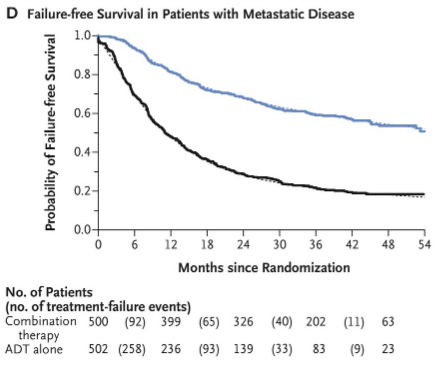
While I’m diving into study data, here’s another graph.  This one shows failure free survival.  Remember failure free survival from a few pages ago?  This is a graph of it.


Let’s look at that black line first.  This is the control group that only received Lupron (ADT).  It tells you all you need to know about median times and how response to treatment varies greatly from individual to individual.  According to this graph, the median time before Lupron fails is about 12 months.  12 months?!?  What chance does anybody have to make it to 5 years?  Actually, about a 20% chance.  Look at how that black line flattens out on the right side.

This is how cancer treatment seems to go.  You get some number of men that don’t have a great or lasting response to treatment, while others have a great response and live for a very long time.  There’s not a lot of rhyme nor reason to who responds and who doesn’t.

The blue line is for the early Zytiga group, and after almost five years the treatment is still working for half the men.

Taken together, these two graphs paint a picture of a miraculous improvement in outcomes.  Not only are men living years longer, but the number of men going well beyond the five year mark is exploding.  This is remarkable progress in the fight against cancer.  Except…

Financial Toxicity

Remember when I said that Zytiga cost about $10,000 a month?  Did you notice how many men are living for 60 or more months while taking Zytiga the whole time?  Yes, you too can beat cancer for five years for the low low price of $600,000.  Oops, I forgot, you’re also on Lupron during that time as well, so that price is closer to $700,000.  If you don’t have drug coverage and live in a nice neighborhood, you could sell your house for five years of living homeless.

If you compare this to the earlier Lupron only example, you will quickly see that, approximately, survival has doubled while the lifetime cost of treatment has gone up by a factor of 10.  I'm not too terribly concerned with the exact number, but did want to point out that these better treatments cost more per month and lead to longer survival, which causes the total costs to explode.

One caveat: Zytiga became available as generic Abiraterone in late 2018 for a much lower price of about $4,000 a month.  This would make the 5-year total cost of Abiraterone and Lupron roughly $350,000.  Yay, half price!

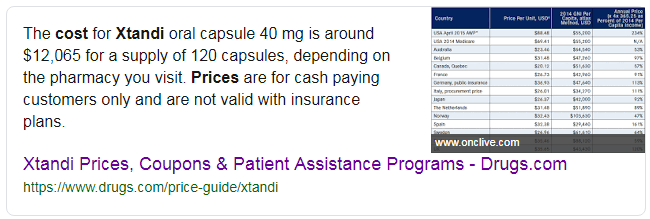
Remember Xtandi?  That’s also roughly $10,000 a month, and no generic is available.  Just to show I'm not making this stuff up:


Another part of the Stampede trial is testing a combination of Zytiga and Xtandi.  Let me paraphrase that study: Can we add a few more years to survival by doubling the monthly cost of treatment?  If the answer is yes, treatment costs for the average patient will now run into the millions.

For now, I'm also going to ignore the issue of side effects accumulating as more medications are used in combination.  Suffice to say some people view cancer treatment as paying a lot of money to feel like crap, "but at least I'm still alive".

These prices are a double edged sword.  Pharmaceutical companies are rushing to develop newer and better cancer medicines due to the insane profits they can make.  This is driving great progress in treating cancer, but for patients, insurance companies, and medicare, it effectively turns a medical disaster into a financial disaster.  Arguing about private insurance versus medicare for all quickly becomes a debate about which one should go bankrupt.  We need to control costs without removing the incentive for innovation.

But enough politics for now.  I don't have any ready answer, just wanted to highlight the problem I see and say it can't be solved with a sound bite.

Coming up in Part 2: Bacteria, cancer cells, and why cancer can be so darn difficult to cure.

Wednesday, June 19, 2019

Day 244, 8 Month Update

Today is the 8 month anniversary of my advanced prostate cancer diagnosis.  To celebrate I went and had a root canal.  This was supposed to be part two of a two part root canal, but as there are still signs of infection there will now be a part three.  Yippee!  While I’m talking about unpleasant things, let me get moment of drama out of the way first.  I am frequently tired, in pain, and have been losing weight recently.  Normally these would be horrible signs for a cancer patient.  But…

... there’s a slight chance these are the result of a massive increase in my activity level over the past month.  I’m now approaching 30 miles a week of walking and running, which does not include other outdoor activities such as mowing the lawn or cutting up downed trees for firewood.

I began running seriously at age 40.  Since then I’ve run a total of 22 5Ks, 6 half marathons, a full marathon, and a handful of other races of odd distances.  Two of those 5Ks have been since my diagnoses, and neither has been my slowest.  In fact, my last one just over a week ago was faster than every 5K I ran at age 40.  So, at age 51 and undergoing cancer treatment, I can run faster and longer than I could when I was a new runner at age 40.

My diet is healthier too.  Recently I’ve been focused on eating more fruit and nuts, and between that and medication side effects the desire to eat less healthy foods in large quantities has waned.  Recently I’ve had to make some effort to eat more to keep my weight up, which is sort of odd.

Today I also spoke with the HR department at the office about returning to work.  I’ve been gone long enough now that I need a note from my treating physician saying that I’m fit to return to work, including the limitations I have that need to be accommodated.  Everybody seems to be in general agreement with the plan, but the paperwork might take a while.

About those limitations: my cancer has been treated very aggressively, with multiple drugs given much earlier in the disease process than would have been done only a few years ago.  This is great for overall survival, but is both costly and causes the side effects to stack up on each other.  I could take this post in a political direction, but will save that for a separate post at a different time.  There’s another soap box I want to stand on today.

I’ve probably said this before, but it seems like every cancer drug has “fatigue” and “pain” listed in the side effects.  I was quite apprehensive before starting the latest drug, fearing that it would lead to a long life of feeling tired and sore all the time.  The internet is littered with anecdotal accounts of men trying to cope with the side effects of these drugs.  Fortunately, there is an antidote: Exercise!

And here I will get out my soap box and stand on it shouting to the world about how important exercise is.  There have been many a day where I’ve woken up tired and sore, and after a five mile run found myself pain-free and energized.  The reason I’m able to do this so easily is because I’ve been running regularly for the past decade, so habit energy is enough to get me out the door and started.

Exercise is vital if you have a serious health problem such as cancer.  A healthy body is better able to withstand treatment.  Exercise stimulates the immune system, reduces pain, and improves mood through the release of beta-endorphins.  Exercise helps maintain a healthy weight and fight metabolic syndrome.  In short, exercise keeps you healthy, and scientific evidence is mounting that healthy people live longer and have better quality of life when coping with diseases such as cancer.

Many forms of exercise will work.  Running, walking, hiking, lifting weights, swimming, biking.  Just about anything that can get your pulse rate up significantly and keep it there for a while.  And now I’ll climb off the soap box.

Despite the voluminous exercise, I do still get some side effects.  Hot flashes happen regularly, and I’m frequently too cold or too hot, and it’s very difficult to find a comfortable temperature.  Pain is very well managed, but still present as a slight discomfort much of the time.  Fatigue still happens occasionally, particularly on a dreary rainy day after I may have overdone things the previous day.

These side effects come and go but are much more likely to show up in the days and weeks after visiting the oncologist and getting my shots.  It’s all somewhat unpredictable at this point, but still improving.  So while I’m planning to go back to work full time in the near future, the process does involve negotiating an accommodation for my somewhat frequent side effect days.

But in the grand scheme of things, I’d rate my quality of life right now as better than it was in the month leading up to my diagnoses. The treatment is decidedly not worse than the disease.  Things are improving further as the side effects from chemo continue to fade.  My runs are getting faster, working in the yard and the woods is slowly giving me back some upper body strength and I’ll be returning to work soon.  In short, piece by piece I’m taking back most of the normal life I had previously, and it feels awesome!

I’ve recently been inspired by dogs.  If you take a middle age dog and tell it that it has a serious disease, what do you think the dog will do?  Will it go online and obsessively search for more information on the disease and how to treat it?  Of course not!  Have you tried to work a mouse and keyboard with a paw?

It may whimper at the vet’s office for a bit, but not long after leaving it will be too busy frollicking in a puddle and generally enjoying the moment.  And that’s how I’m trying to live.  I whimper at the oncologist’s or urologist’s office, but am trying to cut back on the time I spend researching and instead spend more time frolicking.  I feel the need to go jump in a puddle.