Thursday, February 20, 2020

Of Cats and Cancer

Recently I was listening to an online talk about meditation.  Thoughts are transient and without substance.  Think of a thought as a cloud in an otherwise blue sky.  Imagine it dissipating as it slowly drifts away.  Too bad my anxiety fueled obsessive thoughts don’t dissipate, but can remain lodged in my head for hours.

But it wasn’t a useless lesson.  My thoughts are like the cat meowing for his breakfast, insistent and annoying.  If you feed the cat in response, you’ll only encourage it to come back and be more insistent and more annoying the next time.  These thoughts are best ignored or noted for later consideration, but that doesn’t immediately stop them from being insistent and annoying.  I’ve developed an impressive ability to ignore the cat’s meowing, I can do the same for obsessive thoughts.

With my recent third cancer diagnosis, a painful stent in my urinary tract, a bump in my chest from the chemo port, and a case of chemo brain, my head has turned into crazy cat lady central.  I simply can’t count the number of obsessive thoughts meowing away.  Frankly, it’s enough to aggravate my allergies.

The most basic question I face in my life today is which cats do I want to feed?  Which ones do I want to encourage?  Here’s one that’s making a contended purring sound, he gets some kibble.

I’ve written previously about my dire diagnosis and atrocious prognosis.  It’s good to be mindful of it to the extent that it keeps me motivated to stick with the treatment plan and seek out anything that can help me limbo under the low line of the survival curve.  But beyond that, it’s not good dwell on it.  We’ll keep this cat in a crate in a corner of the basement.  That’s not animal cruelty, it’s just a metaphor.  No actual cats are being kept in crates in my basement.

The cat I’ve chosen to adopt, call my own, and allow to freely roam around the house is called Mizuno, the marathon cat.  He was written out of “Cats”, the musical, as his name was difficult to rhyme and sing.  Tough break.  But I digress.

I fully believe that my treatment will be effective and allow me to train for and run a marathon.  If anything, the biggest obstacle between me and my second marathon is overuse injuries to my joints, as that has scuttled several previous attempts.  Since my diagnosis I no longer have a time goal, just a desire to finish a marathon no matter how long it takes.  That will hopefully translate into less joint stress.  In fact, I plan to walk as much as run in this marathon.

It’s a Jedi mind trick I play on myself.  Cancer is not viewed as a deadly disease (though it still is), but treated as a mere obstacle to my marathon goal.  It’s a problem that must be solved.  The tumor in my bladder must be shrunken to the point where the stent can be removed, so that I can resume long runs without pain and blood in my urine.

Being able to envision a meaningful future is key to keeping my sanity.  It’s the difference between enduring cancer treatment, or simply suffering medical torture.  Laying around the house most of the day watching Netflix may sound like a lot of fun to some people, but it’s leaving me quite uninspired.

There are parallels between marathon training and chemotherapy.  Marathon training involves periodic long runs which are stressful to the body and cause it significant damage.  Following each long run it is necessary to rest and have shorter, easier runs while the body recovers from and adapts to the long run.

Chemotherapy is similar. Instead of a long run, the body is stressed by having poison injected into it which causes significant damage.  Following each infusion is a period of rest, gentle exercise, and recovery.  Where chemotherapy and marathon training diverge is that the body generally gets stronger and more fit during marathon training, while with chemotherapy the body is beat further and further down with each cycle.  Oncologists would make bad marathon coaches, as they would definitely overtrain their athletes.

Mizuno, the marathon cat is the cat I choose to feed.  May he live long and have many kittens, including PET, the complete remission kitten, Peaks, the hiking kitten, Splinter, the firewood cutting kitten, and Jobber, the return to work kitten.

Routine Update

Chemotherapy is going as well as can be expected.  While I still have pain, it’s now generally responsive to pain medication and hasn’t gone past the end of the pain scale since chemotherapy began.  As this cancer can’t be tracked through blood tests, there’s no way to tell if this is due to tumor shrinkage, or just my urinary tract settling down after having the stent inserted.  I’ll be scanned again at some point during chemotherapy, and that will show what the tumors are doing.  There will be a lot of scanxiety associated with that scan I’m sure.

Side effects are the usual suspects of nausea and digestive issues and pain, all manageable with pills.  There’s also fatigue, which is exaggerated by the previously mentioned pills, and can’t be helped but to get a bit of exercise and plenty of rest.

Last week, just hours after my most recent chemo infusion I was running around at the indoor track, though with lots of walking because of that annoying stent.  This wasn’t an act of superhero powers, but rather a combination of my fitness from before treatment began combined with dexamethasone keeping the chemo side effects at bay.  Let me put it this way: Cancer and its treatment have reduced me from running 10 miles to walking 2 miles and everybody is just amazed at how active I am, while I look at myself and see an 80% reduction in capability.

And of course, I wrote that paragraph prior to this week’s indoor track session, which turned out to be a bust.  I had overestimated my progress, and started off with too much running on not enough pain medication, and after a few laps had pain and an insatiable urge to pee, even though I just went a moment ago and my bladder was far from full.  So I’m in the bladder penalty box for now, when I recover in a day or so I’ll go back to walking which I’ve been doing recently with increasing success.

But hey, I’m still here, still moving, and still able to cover short distances at a genuine run!  I’d like to give a shout to a couple of my “fans”.  First is Jen, who unknown to her is the head of my cancer battle PR department, for her dedication to always getting an action shot of the two of us at the indoor track (from last week):


Also my sister, for texting me an amusing, personalized cartoon to commemorate my running during treatment.  Yes, I do love these drugs, they are allowing me to continue living life and telling a good story along the way:


And finally, for reasons I can’t really explain I feel a need to close with a topless photo of myself, showing what cancer treatment has done to my body.  Starting at the bottom, my right hand is pointing at a little green dot tattooed onto me and used as an alignment mark during radiation treatment back in 2018.  The first three fingers of my left hand are pointing to the incisions made when installing my port.  They look like I just scratched myself in the photo, but they're scars which trace the path of the tubing from my port, up and  over the collarbone and into a vein.  The pinky finger is pointing directly at the port, which looks almost like a third nipple.  Good luck getting that vision out of your head.  And finally, my chemo-fro hair do, which is still curly from the first chemo treatments.  I’ve let it grow completely wild, expecting it to fall out again in a week or two.

Some people may look at this photo and remark at the muscle atrophy caused by androgen deprivation therapy, but no, I've always been scrawny like that.

Sunday, February 9, 2020

Out of Surgery and Into Chemo

The Battle Begins

Within 24 hours of writing this, I’ll be having the first infusion of my second course of chemotherapy.  Compared to my first course, this will be a completely different cocktail of drugs, for what is effectively a completely different cancer.  It will be the first meaningful shot fired by the good guys in cancer war 2.

For those unfamiliar with chemo, treatment is scheduled as a series of cycles, with each cycle usually lasting 3-4 weeks.  At the beginning of each cycle the chemotherapy drugs are given, and then during the rest of the cycle the body is given a chance to recover before the next cycle.  And generally, it’s the bone marrow and associated blood counts that take the majority of the collateral damage, which limit the drug dosages, and determine the time between cycles.

My cycle will begin with three consecutive days of infusions.  On the first day I’ll be given a pre-treatment of diphenhydramine (Benadryl), dexamethasone (a steroid), famotidine (Pepcid), and if I recall correctly ondansetron (anti-nausea).  These are all intended to suppress allergic reactions to the chemotherapy and limit the initial side effects, and they work very well.  I’m particularly a fan of dexamethasone, as it generally makes me feel like superman for a few days.  Last year, dexamethasone is the reason I was able to go running around the indoor track the day after a chemo infusion.  When it wears off the side effects hit like a bomb.

After the pretreatment comes an infusion of Carboplatin, which is basically a platinum atom with a few other atoms attached to help shepherd it through the system (don’t quote me on that explanation, it’s probably wrong).  In this context, platinum is a heavy metal that is toxic to all cells, and shows a slight propensity for accumulating in cancer cells.  This has been around for decades and is very effective treatment if a bit nasty in terms of side effects.  It’s the Rambo of chemotherapy drugs, “his job was to dispose of enemy personnel... to kill, period! Win by attrition”

That will be followed by an infusion of Etoposide, which is another old chemotherapy drug.  It interferes with the copying of DNA during cellular division and effectively kills any cells that try to divide (again, don’t quote me on that explanation).  This is where chemotherapy can be a bit counterintuitive.  It is more effective against cancers that are growing and dividing at a faster rate.  Because more of the cancer cells will try to divide while the drug is present, a larger percentage of the cancer will be killed.  Slower growing tumors are able to resist treatment simply because the cells are not as likely to divide during treatment.

And finally, I’ll get an an infusion of Atezolizumab which is a relatively new immunotherapy drug.  Here’s my weird way of describing how it works:  Healthy cells express a protein called PD-L1 on their surface that functions as a name tag.  They say “I am Tom”.  The immune system sees the name tag and doesn’t attack the cell, because attacking “Tom” cells would be an auto-immune disorder. This is also referred to as an “immune checkpoint”.

Some cancer cells are able evade the immune system by covering themselves with multiple name tags.  “I am Tom” stuck on the front, back, sides, and top.  There’s no way for the immune system to look at this cell and not thing it’s a healthy Tom cell.  What the drug does is effectively rips the name tag off of all cells, allowing the immune system to go after the cancer cells, and possibly perfectly healthy Tom cells.  To put it more scientifically, the drug is a PD-L1 antibody, and is in a category of drugs called “checkpoint inhibitors”, because they remove the checkpoints that prevent the immune system from attacking.

This all adds up to about 3-4 hours hooked to an IV having chemicals pumped into my veins.  I’ll make sure to have my phone and tablet fully charged.  At to that the 2+ hours driving to the office and back home afterwards, plus any time stuck behind school buses and general commuter traffic delays.  It’s gonna be a long day.

On both Tuesday and Wednesday I’ll get another infusion of Etoposide and some amount of pre-treatment depending on how well I tolerated the infusion on Monday.  This will go much faster, and probably be only a 90 minute visit.

That’s three days of infusions, probably about 6 hooked to an IV, another 6 hours of riding in a car, and however many hours and days of side effects once the supporting drugs wear off.  This week my battle with cancer will be a full time job.

After that I’ll get two to three weeks of recovery time, depending on how fast my blood counts recover, to get ready for the next cycle.  Repeat for six cycles, and I’ll be doing this until around July.  After that, I’ll continue to get the Atezolizumab infusions regularly as maintenance therapy.

Surgery Report

Last week I had surgery to install a power port (no, I can’t charge my cell phone with it) and what is called a double-J stent.  Let’s start with the stent.  No, wait, let’s back up a couple weeks to my liver biopsy.

An interesting aspect of the human body is that if you stick a rather large bore needle all the way into the liver to take a tissue sample, when you pull the needle out the flesh will close around the hole left by the needle and in a very short amount of time will seal the hole and begin the healing process.  There’s no need for stitches or glue or other such wound closures if the hole is small enough.

I was fully expecting the urinary stent would be inserted from the “bottom up”, with my urologist going into the bladder via the only entrance that doesn’t require an incision, finding the blocked ureter, and forcing the stent in.  Unknown to me, my doctors have been talking amongst themselves again and decided this was a better job for an interventional radiologist.

Until a few weeks ago I never knew there were interventional radiologists.  They use radiology (CT scans, fluoroscopy, etc.) to guide them through medical procedures such as placing a biopsy needle right into the middle of a liver tumor.

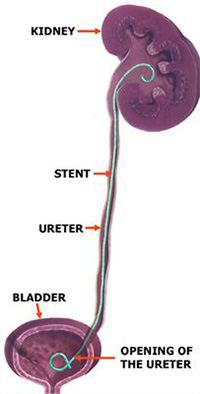
For the stent, fluoroscopy would be used to poke a needle into my backside and into the portion of my kidney where the urine collects, sort of like sticking a straw into a juice box.  Then a wire would be passed through the needle, down the ureter, and into my bladder.  The stent is then pushed over the wire and follows it down into my bladder.  When the wire is removed, the ends of the stent coil up (thus, “double J”) and help hold the stent in place.  If everything went well the needle would be withdrawn and my body would close up and begin healing with the stent left inside.  If not, the needle would be hooked to an external nephrostomy bag to collect the urine produced by that kidney which couldn’t find its way down to the bladder.

Image result for double j stent

As I noted earlier, this plan was created by my doctors without anybody telling me.  The first I heard about it was from the poor innocent nurse who was giving me the boilerplate explanation and disclosing the possibility that I might end up with a nephrostomy bag.  You could say I broke down at this point, but for the purposes of better story telling I metaphorically jumped up like a scalded cat and dug my claws into the ceiling.

Of course, having been through a similar scenario just a couple weeks ago with the biopsy I expected the radiologist to be able to peel me off the ceiling and explain everything.  I know now that numerous e-mails were exchanged discussing my case, and my urologist thought it would be difficult for him to get the stent in place entering from the bladder, so deferred to the integrative radiologist.  He said nephrostomy bags are relatively rare, and he usually can tell from the scans when one might be needed, and didn’t see anything in my scan that would pose a problem

I like my medical team, but patient communication definitely gets a “needs improvement” mark.  Still, if their time is limited I’d much rather they spend it talking amongst themselves and making good decisions than keeping me informed.  As has happened twice in the past three weeks, I’ll find out about the change in plans and recover, eventually.

And in the end, the stent went in easily, no nephrostomy bag for me!

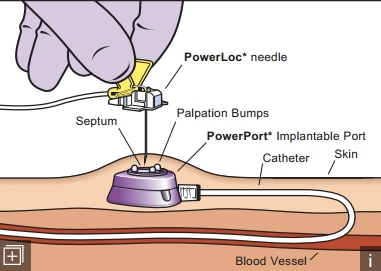
On to the power port.  This is a device implanted under the skin that consists of a tiny reservoir for receiving chemotherapy drugs connected to a somewhat major vein at the base of my neck.  Compared to finding a vein in my arm for an infusion, the port is the proverbial broad side of the barn.  You can’t miss it.  Also, because it goes into a bigger vein than those in my arm, the drugs are instantly diluted to a greater extent and less like to burn the vein.  After multiple missed veins and two burned veins in my previous course of chemotherapy, I’m looking forward to having a port this time.

Image result for power port
The port was also inserted by the integrative radiologist, and this did require several incisions and stitches/glue/tape.  I was under “conscious sedation”, and was aware of him cutting into my skin, though I felt no pain.  I may have remarked verbally about it.  They may have upped my dose of sedation as a result, because I seem to have fallen back to sleep shortly afterwards.

In the end that went well, and I’m slowly getting used to having a bump in my chest and what feels like a string connecting it to the base of my neck.

After the Surgery

I expected miraculous improvement after surgery, mostly because ignorance is bliss.  Just two weeks prior I underwent a liver biopsy and then the very next day walked and ran a combined three miles at the indoor track.  This surgery was going to finally unblock my kidney, how is that not going to make things instantly better?

The good news is that it did instantly stop the bouts of severe, kidney stone levels of pain that could last for several hours at a time and didn’t respond to any pain medication available to me.  As a human being I’m very pleased with that.  As a runner, I haven’t even been able to walk a mile since the surgery, so fitness fanatic Tom is a bit disgruntled.

Let’s back up a few months.  In October I ran a half marathon and didn’t need to stop once to take a pee.  After the race I wanted to ramp up my mileage and try to complete a 15 mile training run before the end of 2019.  That didn’t happen.  The weather got colder, and my bladder got very sensitive to running.

As a result, every mile or two I’d have to hide behind a tree and relieve myself.  Urination was becoming increasingly painful during this time.  There was snow on the ground so hiding behind a tree meant getting my feet cold and wet.  All this sapped the joy out of running.  By the beginning of 2020, running caused blood in my urine, and that’s when the doctors started getting interested in my symptoms.

So my running had been reduced to mostly walking, and distances were reduced to two to four miles.  Somehow, I magically thought a urinary stent would allow me to go right back to running 10 miles at a time.  But no.

If you asked me, the purpose of the stent was to improve my running.  I’m sure if you asked my doctor, he’d say something more along the lines of it was intended to restore kidney function, which is vital when he’s about to pump bag after bag of toxic chemicals directly into my bloodstream.  The sheer fluid volume would otherwise exacerbate the pain and the kidney damage.  Worse yet, reduced kidney function might limit clearance of the drugs and increase toxicity.

Still, I’m human, and I’m bummed that the stent is going to interfere with my running.  There’s two problems the stent poses:

First is that the stent has exacerbated the painful urination.  Previously, I would have rated the pain at 10, or “worst imaginable pain”.  It seems I lack imagination.  The current pain I feel urinating is indescribable, but I’ll try to describe it anyway.  Imagine the worse muscle cramp you’ve ever had.  That’s what my bladder feels like trying to squeeze out the last few drops of urine, and that’s probably more due to the cancer than the stent.  Now, imagine that as the bladder is cramping and squeezing, it’s also impaling itself on the foreign object that is the stent.

I generally pee sitting down now, because it’s difficult to stand upright when the pain hits.  I’ve developed a preference for the handicapped stall in public restrooms, because I can grip the handrails tightly and help hold myself on the toilet.  Like Spinal Tap, my pain dial now goes to 11.  On the bright side, this only lasts for a minute or so.

The second problem with the stent is that even when I’m not peeing it’s still generally irritating my innards, and activity makes it worse.  I suspect my body will get used to it, and perhaps even build up internal callouses to protect itself.  But at this point, I don’t know how much walking or running I’ll be able to do with the stent in place.  I may have to wait for treatment to shrink the tumors to the point where the stent can be removed before resuming copious levels of activity.  I expect I’ll be able to do quite a bit by normal person standards, but not by marathon standards.

So to bring this lengthy post to a quick end, chemotherapy starts tomorrow and let’s all hope that shrinks the tumors and makes life with the stent a little more bearable in the near future.

Monday, February 3, 2020

Reality Brick


Latest News

Since my last post, a PET scan has allowed my oncologist to give me a specific diagnosis (read on for details) and create a treatment plan.  On Wednesday I'll be going into the hospital to have a stent inserted into my ureter to unblock my kidney, which should relieve at least some of the pain I've been experiencing.  While I'm there, they'll also be putting a chemo port in so that the nurses won't have to play hide and go seek with my veins.  That's two minor procedures back to back in the same hospital.  One trip to Framingham and one recovery process for both procedures.  Convenient!

Chemotherapy should be starting next week, exact time and date have not been scheduled.  Finally I'll be able to go into attack mode and hopefully the rest of my symptoms will go away as the tumors shrink.

Symptoms?  Yes I still have plenty of pain, but it's mostly under control.  Despite my suggestion in my previous post that I didn't need opioids, I'm still taking them regularly because I can't take enough Ibuprofen in a day to keep me comfortable.  I must have written the previous post on a good day.  As an aside, if the smallest dose of aspirin is called "baby aspirin", then I'm on "baby opioids".

Despite that, I'm still making the most of each day.  I'm still able to drive around, go for walks (not so much running), and carry firewood up stairs to the wood stove.  Here's a random picture of me posing by the stove with a piece of firewood:


I've also temporarily suspended my attempts to eat healthy.  In fact, I'm trying to gain a few pounds, or at least stop some recent minor weight loss before starting chemotherapy.  Food will be tasteless and I won't have an appetite in a little over a week.  So today I ordered an omelette with sausage and mushroom for lunch, and it was fantastic.  I never knew an omelette could taste "chocolate good", but this one did.

Reality Brick

This post grew out of a conversation with my wife.  I was lamenting that my drafts of possible blog posts were too depressing.  She pointedly asked why they all need to be positive and inspiring?  She's had to remind several people that I'm still on treatment for my original cancer, and should not be considered cured or cancer free.  I admitted to some complicity in this because I grew weary of explaining incurable cancer, and for my own sake I wanted to believe in the improbable.  And so, with that in mind, I'm going to hit you and me in the face with the harsh brick of reality.  Try not to flinch.

A few months ago I ran a half marathon to celebrate the anniversary of my original cancer diagnosis, and everybody cheered.  I had beaten cancer!  However, even at the time of that half marathon I was already having some minor urinary symptoms that in retrospect were the first signs of cancer growing in me again.  We all raised the "Mission Accomplished" banner too soon, not realizing that my enemy was a disorganized band of terrorist cells that had no centralized leadership that could surrender.

My symptoms got worse, and I eventually went to the ER with severe pain that turned out to be caused by a tumor in my bladder blocking my right kidney.  More tests followed.  Eventually I got a specific diagnosis: neuroendocrine prostate cancer.  This is a rare and very aggressive form of prostate cancer that can't be detected using blood work.  I'll need regular scans indefinitely to track cancer activity.

It's not clear to me how this cancer developed.  My oncologist says it started when the normal neuroendocrince cells in my prostate turned cancerous.  However, there's plenty of evidence in the scientific literature that aggressive treatment for normal prostate cancer can cause it to undergo epigenetic changes and transform into the neuroendocrine form.  It's possible treatment caused my existing cancer to change into this new form, but in my specific case there's several reasons to believe this didn't happen.

In either case, once again there is rare, aggressive, metastatic prostate cancer running loose in my body and the diagnosis hit me like a brick in the face.  I knew that I was likely to redevelop cancer at some point, but was hoping it would take a few more years. Let's use this unfortunate development as a teachable moment.  This is the reality of living with incurable, metastatic cancer.  A cancer patient can look healthy, can feel healthy, can even run long distances, but cancer can come back at any time.

In talking online with other survivors, the vast majority of people that have lived with metastatic cancer for 10 or more years have fought back and forth battles where the cancer repeatedly returns but responds to treatment.  Usually in these cases there's a new or otherwise unused treatment available to beat the cancer back again.  Each treatment gives more time for a newer, better treatment to become available.  Some have literally surfed from one new treatment to another for 10 or 20 years or even longer.

The point is that long term survival doesn't usually mean being cancer free the whole time.  It's more like fighting a series of individual wars against the same enemy.  It's very unlikely for any treatment to drive metastatic cancer to extinction (thus, it's considered incurable).  Those cancer cells that do survive treatment are immune to that particular treatment and sooner or later will regrow into tumors.  Thus, the cancer comes back in a more aggressive, harder to treat form.  Shortly after my diagnosis a 10-year survivor on the forum had a recurrence and died a couple months later.  He went from happy and healthy cancer survivor to cancer victim with shocking speed.  An inspiring story of survival came to a sudden end.

This is the harsh truth I've been hesitant to share.  There are real reasons for hope and optimism, but ignoring the reality of the situation doesn't help.  It's reasonable to expect there will be multiple battles, and I'll need the same support and encouragement in each one of them.  Don't be surprised when a battle won is not the end of the war.  I've got a couple more bricks, then we can talk about hope.

Let's throw out some statistics.  For neuroendocrine prostate cancer, about 80% of patients will respond to chemotherapy, but the cancer will return in about 6-18 months.  Statistics apply to populations, not individual patients, but let's pretend for a moment I respond to treatment and get 18 months before the cancer returns.  I'll start feeling much better by summertime.  I'll enter 5Ks again, and hopefully run a fall half marathon.  Continued training over the winter would allow me to run a full marathon in the spring of 2021.  I'll feel fantastic.  Another victory over cancer, and believe me, it would be a genuine victory.  But by fall of 2021 my scans would show an small increase in tumor size.  By winter of 2021 it would be clear the cancer is growing again.  Would there be another treatment available to beat it back again?  I don't actually know.

The five year survival rate is only 15%.  That means 85% of patients don't even live that long.  And that's just for the neuroendocrine cancer.  My "normal" prostate cancer (which is also a rare and aggressive form) could also recur.  I could also have another bladder tumor.  By my oncologist's count I've had three cancers and any one of them could recur at any time.  Forgive me if I sometimes don't like being told "you got this!" or "you look great!".  There was a long discussion on the cancer forum where most men agreed they all hated hearing these things.  But I digress.

I'm done hitting us in the face now.  There is hope.  That 15% survival rate is not a quota.  Oncologists don't shoot patients for fear of having too many survivors.  The trick is to figure out what can be done to increase the likelihood of being a long term survivor.  And generally, survival statistics are right skewed.  Old age is really the only limit to how much a patient can outlive median survival.  For more on this line of thinking, read this piece by Stephen Jay Gould.

A minority of patients get exceptional responses to treatment.  If you consider my neuroendocrine cancer as a separate cancer, then I've already had an exceptional response to treatment for my other prostate cancer and that treatment is still working.  There's every reason to believe I'll get an exceptional response to treatment for the neuroendocrine flavor.  I believe that exercise, maintaining a healthy weight, and having a good laugh regularly all help with response to treatment and survival.  At the very least, they all help in coping with treatment, and treatment can't work if you can't tolerate it.

I've also held back a teeny weeny detail.  In addition to chemotherapy, I'll also be getting a relatively new immunotherapy drug.  I don't have any statistics on this drug.  If it's like other immunotherapy drugs, then it only provides a significant benefit in a minority of patients.  But, when it does provide a benefit, it can be nearly miraculous.  The drug cocktail I'll be receiving is also used for small cell lung cancer patients.  My oncologist had a lung cancer patient that took this immunotherapy drug for two years and the scans couldn't find any cancer by then.  They stopped treatment and she lived for another three years before dying of a heart problem.  She was in her 80s, who knows how long she could have survived her cancer if she was younger.

Here's another thought:  Laughter produces endorphins.  Endorphins stimulate the immune system.  Shortly I'll be on immunotherapy that uses the immune system to fight cancer.  Ergo, laughter helps me fight cancer!  I'm really not silly, I'm a cold and calculating murderer of cancer cells.  Bwahahaha.  Seriously, one of my strategies is to laugh so much I'll be late for my own funeral.

It's unlikely I'm at the end of my road.  Most likely I'll travel a bumpy and rocky road for quite some time.  There's even a small chance it will be a long smooth road.  Anything can happen.  Hope comes not from ignoring the negative possibilities, but from realizing the worst case is not guaranteed, and the best case is not impossible.  We literally don't know how well immunotherapy could work.  Will my scans show no cancer two years from now?  I just don't know. I really just don't know. I'm afraid I really just don't know. I'm afraid even I really just don't know. I have to tell you I'm afraid even I really just don't know.

And I quoted Monty Python in another blog post.  Bugger.

Friday, January 24, 2020

Day 463, Cancer Number 3?

This has been a dastardly difficult post to write, mostly because my situation has been changing drastically every couple days.  I write a draft, set it aside for later word smithing and editing, and then there is new news that invalidates half of the previous draft.  I will forwarn you, the reader, that any information contained in this post is not a medical diagnosis, but rather combination of test results and best guesses by me medical team and communicated by a rather frazzled abd sometimes silly cancer patient with no formal medical training, unless you count high school biology.  You are also advised against eating anything while reading this post.

Let’s go back to the beginning of January, I had some unexplained urinary pain but no other signs of cancer.  PSA was undetectable, other blood results were normal-ish, cystoscopy showed everything clear in the bladder, and so my medical team was more than happy to give me a clean bill of health and blame my symptoms on friable tissue seen in the prostate at the end of the cystoscopy.  Spring is only a few months away, it was time to start thinking about vacations and how I’d go about training for a marathon.

A few days later I went to the emergency room with severe, writhing on the couch abdominal pain, thinking I had appendicitis or a kidney stone.  Nope, CT scan shows those are all fine, but it did show a large growth in my bladder.  WTF?  So they called my urologist who basically said “WTF, I just looked in there and it was fine”, so they changed the description to “prostatic mass” and sent me on my way with an antibiotic prescription and instructions to see my oncologist.

Oncologist looks at the scan and basically says “WTF!”.  Suffice to say nobody on my medical team was expecting anything like this.  But at the time he was optimistic and thought that chemotherapy and radical cystectomy (removal of bladder) might be curative.  He sent me on my way with a prescription for Percocet and a plan to get a bladder biopsy.  While I’m not really thrilled at the thought of losing my bladder, how upset can I be when my oncologist is optimistic?  As a bonus, they’d probably also remove the prostate, thus getting two primary tumors out of my body for the price of one.

Fast forward a few days and it’s time for my biopsy.  I can’t even remember this specialist’s name, that’s how frazzled I’ve been.  Anyhow, he said biopsying the bladder would be risky for his flavor of biopsy, as it would poke a hole in it and allow the urine to leak out internally.  It would be much safer if he could get a sample from my lungs or my liver.  My what or my what???  So into the CT scanner I go, and he finds a spot on the liver that’s not very deep and proceeds to stick needles into my side.  I was conscious for all this by the way, but drugged.  As things move around when breathing, I had to take a consistent breath, hold it, and then stay still while he moved the needles around, then back into the scanner to see if they’re in the right place yet.

A few years ago this would have been a horror story to me, but now it’s just a semi-regular part of life.  Interestingly, most of these procedures are much easier to endure than a 10 mile run.  Also, once you’ve experienced cancer symptoms, medical torment feels like a kiddie roller coaster by comparison.

Up until this point in the story I’ve spent the vast majority of my time lying on the couch or napping in bed, owing to a combination of antibiotics, opioids, and symptoms.  The frequent severe pain is thought to be caused by a restricted ureter, causing urine to back up in my right kidney leading to pain and infection, quite similar to if I had a kidney stone.  Those who are better at reading CT scans than me assure me that this particular kidney does not look happy.

My antibiotics were finished on the day of my biopsy.  Since then my pain levels have plummeted and can largely be controlled without opioids.  This would normally be good, except that lower pain levels allowed me to relax and begin to emotionally process the events of the last couple of weeks.  I’m back on medical leave from work, it’s difficult to run long without aggravating my symptoms, and they just biopsied my liver.  They wouldn’t biopsy the liver if they didn’t see something on the scan worth biopsying.  “Fuck, I’m going to die”.  I have been slapped in the face with the cold fish of mortality again.  And I can’t even share a dark, depressing moment without turning it into a Python reference.

A lot of this darkness was driven by the thought that the most likely outcome of the biopsy would be bladder cancer metastasized to the liver.  That would be bad.  My life would be in Jeopardy:

    “I’ll take deadly cancers for $500 Alex”
    “This cancer’s death rate is comparable to advanced pancreatic cancer”
    “What is advanced bladder cancer?”
    “Correct!”

Late yesterday I got a call from the oncologist with the initial biopsy results.  “Undifferentiated cancer”.  They’re still running tests, but have confirmed it is cancer.  Strangely, it doesn’t appear to have originated from my bladder, prostate, or liver.  This could be a new, third cancer, or it could be cancer that’s mutated so badly as to no longer be able to determine where it originated from.  This is where my lack of medical knowledge causing things to get lost in translation.  I’ll also add “Martian cellular invasion” and “Zombie apocolypse” to the potential final results of the biopsy to demonstrate the full depth of my knowledge in this area.

Somehow, I’m actually upbeat about this latest news for many reasons.  It’s still possible they will identify this as a specific cancer that could be more treatable than advanced bladder cancer.  If it didn’t originate in my prostate or bladder, then all those checks for recurrence of those cancers weren’t in vain, they just weren’t looking for new cancers.  A third cancer could make me a bit cocky.  “You’ve seen what happened to those other two cancers that messed with me, haven’t you?  I’ll give you a week to leave my body quietly before kicking your ass.”

Most importantly it’s a reminder that you just never know what’s going to happen when you wake up each day.  Normally, this is a real drag because how do you plan anything in life when you can’t reasonably expect to be healthy on any specific day?  More specifically, how do I train for a marathon when runs over a couple miles chafe my bladder tumor?  It’s enough to make me want to cry.  Und I did.

So here I am again, 463 days, about 15 months after my life was ripped to shreds by my original cancer diagnosis, waiting for the specifics of my next diagnosis and standing in the rubble of the new normal life I had pieced back together.  Depressing, isn’t it?  Well, I’m hoping I hit bottom a couple days ago.

As I’m increasingly able to control my pain without opioids, I can get hours to do things during the day.  It’s a gorgeous January morning, so I’ll probably head out to the garage later and give the snow thrower an oil change.  Generally I hope to get a few things accomplished and have a few laughs along the way.  At this point it’s reasonable to expect I’ll wake up tomorrow, and the day after, and so on until the day they figure out which chemotherapy should work best for me.  With luck that will beat the disease back into remission giving me many more days to wake up and figure out what to do and what silly thing to post to the internet.

While I still have my dark moments, I’m focusing on taking one step at a time and putting the pieces of my life back together as I can.  In closing, let me stress how vital a sense of humor is in a time like this.  How do you seize the day and savor every moment when you’re writhing on the couch in agony?  Well, within a few hours of that awful moment, I pulled up some Monty Python on Netflix, and happened to re-watch the fish slapping dance.  I can’t resist giggling at this short sketch.  What in life could possibly be so bad that I wouldn’t laugh at it?

Let me leave you with this thought:  When things get really bad and I can’t take it anymore, I’m going to load up on painkillers, grab a fish, travel to the local mall, and start slapping random people with the fish.  When the police arrive I’ll drop the fish, pull out a banana, hold it over my head, and charge them with a fierce scream.  Now matter how that ends I’m sure it will be a once in a lifetime experience.


I’m relatively certain such an act will make the news, so if you watch the news and this isn’t the lead story, you can rest easy in the knowledge that I’m coping with things okay.

Friday, January 10, 2020

14.5 Months and Friable Tissue

The decade of the 2020’s is off to a roaring start!  Let’s recap the latter part of 2019 to set up the events so far in 2020: Way back in September I started having some odd sensations when relieving myself.  This was mentioned to both my oncologist and urologist at routinely scheduled appointments.  All signs pointed to my prostate cancer being under control, and my bladder cancer being entirely eradicated, so everybody including me was happy to ignore that symptom at the time.

These routine appointments are a bit like Groundhog Day.  If the doctor doesn’t see my shadow, then the cancer is considered in remission and it’s three more months of dancing happily in the sun for me, and then the whole process repeats.  I repeatedly wake up to “I got you babe” playing on the clock radio, go get a blood test, and wait anxiously for the results.  Every.  Three.  Months.  At least that’s how it’s supposed to work.

It’s perfectly normal to have some anxiety about these appointments.  If signs of cancer are found it can mean more tests, changes in treatment, surgery, radiation, who knows.  The new normal life I’ve been building gets thrown out the window.  It’s quite a bit like applying to college every three months.  There’s the nervous anticipation of not knowing, and thinking about how drastically the future direction of your life depends on the answer.

So when I went to the mens room on my way to my oncology appointment, and saw pink lemonade going into the urinal, my heart sank.  Blood in urine, or hematuria, really gets doctors’ attention.  They like to run more tests.  This was actually the exclamation point on the gradual change in my symptoms from “strange sensation”, to “discomfort”, to “painful urination”.

Here are some interesting stats:  Blood in the urine usually has a non-cancerous explanation.  But if you do have bladder cancer, there’s an 85% chance you will see blood in your urine at some point, and a 99% chance you’ll test positive for blood in urinalysis.  It’s very treatable if caught early, so it should be high on the list of things to check when there is blood in urine.

When I mentioned this latest development, my oncologist literally tossed me a container for a urine specimen and said “Merry Christmas” while it was in the air.  It came back positive for blood and negative for anything else of interest.

My blood test results were fantastic.  PSA < 0.01 (no detectable prostate cancer activity), alkaline phosphotase at 43 (no meaningful bone activity), no anemia, etc., etc.  If my prostate cancer is doing anything it’s going about it quite discretely.  My blood looks absolutely marvelous, except when it’s in my urine.  So off to the urologist for what really is a urology problem.

The standard procedure at the urology office is to pay your copay and give a urine sample. Apparently anxiety makes my symptom worse, because this was a super painful urination.  It’s the kind of pain that makes you want to jump around screaming then curl up into a fetal position.  It’s hard to stand upright when the pain hits.  And here I am with a half full specimen container in one hand, and using my other hand to aim the rest of my bladder contents into the toilet bowl and trying not to water the walls and the floor and spill my sample as my body wants to convulse.  Too much information I know, but it’s one of those moments where having cancer feels like a screwball comedy movie.

Back to my appointment.  I like my urologist.  When something is worrisome to him, he is extremely proactive.  He moved up my CT scan and biopsy after seeing my PSA test.  My bladder surgery was about two days after after my bladder cancer diagnosis.  When he sees a problem he takes action immediately.

The only thing I don’t like about him is his tendency to want to stick things into that most personal of male body parts.  So of course, when I say “it hurts when urine comes out”, his response is “can I stick a scope in there?”  And wow did this cystoscopy hurt!  The nurse was telling me to relax and breathe and I muttered something about childbirth in reverse.

Good news!  My bladder is still marvelously clear of any growths, but while removing the scope the doctor found the source of the blood.  I have friable tissue in my prostate, but it can be removed by fulguration if it doesn’t resolve on its own.  Huh, what?  I have fry-able tissue that you can, um, fry?

The wonderful thing about the internet is that after my appointment I was able to see his notes from my appointment and use the internet to look up terms.  “Friable” actually means “tissue that readily tears, fragments, or bleeds when gently palpated or manipulated”.  If I understood the urologist correctly, it’s quite common after radiation, except I didn’t have radiation to the prostate.  When I asked if it could also happen due to chemotherapy and hormone therapy, he didn’t immediately dismiss the idea, as he’s done with other ideas I’ve had.

So my cancerous prostate has tissue that easily tears and bleeds, which is in a way is a huge “no duh!”  The optimist in me sees this as being a logical result of cancerous tissue shrinking and dying off.  My proactive urologist told me to come back in four months, but to call him if it gets worse in the meantime.  I’m not having any trouble with urinary retention, and with that undetectable PSA it’s highly unlikely this is the result of active cancer.  In summary, no need to worry at this time.  Now I can truly celebrate my undetectable PSA!

There’s a small chance this problem is a side effect of Xgeva, and after months of lobbying my oncologist he finally agreed to reduce the injections from every four weeks to every eight weeks.  So maybe by the time February rolls around this will all start going away on its own.

If it doesn’t go away I can have surgery to remove the offending tissue and have it sent for biopsy.  I have mixed feelings about this, as I’d like to avoid anesthesia and if this friable tissue is just the tip of an iceberg then how could it be a permanent solution.  But it is an option.

Then it was back to the office to finish my workday.  How do I respond to smalltalk when people ask “Hey Tom, how’s things?”  “Oh, I’m pissing blood today, how are you?”  “I just had a cystoscopy during lunch, and you?”

It’s more than just small talk.  Prior to my appointment, when we were discussing plans and schedule, how much do I say?  That appointment could have led to all sorts of other appointments, tests, or even surgery (which is still a future possibility).  This time, I said something like “I have an unexpected medical appointment, and there may be more after that one”.  It’s factually accurate and doesn’t go into any details.  My read of my coworkers is that they are truly interested in my cancer journey, but perhaps not so much about some of the more personal details I love putting into this blog.

So that’s just the first 10 days of the new decade.  Let’s hope the rest of January is a bit more boring!

Tuesday, December 24, 2019

Over the Rainbow

Somewhere over the rainbow, Skies are blue,
And the dreams that you dare to dream, Really do come true.

My Christmas wish is for everybody to have dreams for 2020, and dare to dream big.  Then, go out there and make those dreams a reality.  I dream of running marathon number two, despite having metastatic cancer and with a lifetime of active treatment ahead of me.

There’s two reasons for me having such an apparently crazy dream: Last year I dared to dream of running half marathon #7, and pulled that off with great success.  It went so well that in retrospect it almost feels like it was a publicity stunt.  After all, it was well less than three hours of activity, how hard is that?  For me, it felt much less strenuous than a normal workday, and I got to nap in the afternoon.

The second reason is that I have unfinished business with the marathon distance.  I was lucky enough to be able to run the Boston marathon in 2011.  It was the best of times and the worst of times.  I was running the most famous marathon in the world with my friends in the running club, but as an athletic performance it sucked.  I was under trained and not mature enough as a runner.  But there was a qualification waiver available and to this day I’m very glad I didn’t pass up the opportunity.  For a runner, a Boston waiver is like getting the golden ticket to the chocolate factory.

I vowed to do better in my second marathon.  I vowed not to be “one and done”.  I subsequently developed overuse injuries in every attempt to train for another marathon.

My cancer diagnosis has given me permission to try again, and a reason to focus on just finishing the race and not worry about time goals.  I’m not crazy, I only expect to pull this off by approaching the race differently than in the past, but the details of that are the subject of a future blog post.  Suffice to say marathon #2 won’t be Boston.  It will be a smaller race that’s friendly to walkers and with a generous time limit, and I don’t yet know which specific race it will be.

Perhaps it’s a side effect of the medical marijuana, but I’ve come to view a full marathon as being on the other side of that rainbow Dorothy sang about decades ago.  I dare to dream of running another one.  I want to get to the other side of the rainbow and shout back to other cancer patients “It’s okay to have dreams!  Come join me!”.  It doesn’t have to be a marathon.  Just choose your rainbow and find a way to get over it.

Other people have already run marathons after receiving diagnoses similar to mine.  I won’t be the first one to reach the other side of this particular rainbow.  I’m simply following in the footsteps of others who are already on the other side and are shouting back to me.  I hear you Randy!

Of course, such paths are rarely straight and without a fair number of bumps and twists and turns along the way.  A marathon is much more than twice as difficult as a half marathon.  For me, half marathons were and now again are a solved problem.  Running a marathon was extremely difficult for me before diagnosis.  Being 9 years older and having had two cancer diagnoses won’t make it any easier.

But just imagine how epic it will be when I cross that finish line!  After crossing this rainbow, what will my next dream be?  A complete and durable remission?  Perhaps a cure?  My cancer is considered incurable, but there are fluke cases where men get off treatment and the cancer doesn’t return.  Failing that, a prolonged response to my current treatment may allow time for a breakthrough in immunotherapy or some other new treatment with curative potential.  There are men alive today who are having success keeping their cancer under control with treatments that didn't exist when they were diagnosed more than a decade ago.

Anything resembling a cure is a very long shot, but people dream of winning the lottery.  Arguably, my chances of achieving something resembling a cure in my lifetime may be better than the chances of winning the mega millions jackpot.

Some day I'll wish upon a star
And wake up where the clouds are far behind me
Where troubles melt like lemondrops
Away above the chimney tops
That's where you'll find me


p.s. Scrubs is one of my favorite TV shows of all times.  It’s like M*A*S*H in its ability to combine comedy with moments of true drama.  And it was filmed in a former hospital, allowing for scenes both inside and out.  Just think of the planning and effort that went into getting that sequence at the end of the video in one continuous shot with no edits!

p.s. 2, Sam Lloyd, who plays the inept lawyer “Ted” on Scrubs, was diagnosed earlier this year with inoperable and widely metastasized cancer, but appears to be responding to treatment.  Off the set, he’s in an acapella group called “The Blanks” that has been written into the show on numerous occasions.  That’s him, second from the left on the rooftop.

Tuesday, December 10, 2019

Day 418, Update and a New Hobby

Quick Update

It’s been a while since I’ve posted and the delay has been for a variety of reasons, but mainly there hasn’t been much news to report and I don’t quite know how to follow up my half marathon.  That was an epic day, as the race perfectly lined up with an ebb in my symptoms and side effects as well as ideal running weather.  How can I top that?  What could I possibly do that would be TWICE as good as a HALF marathon?  That not-so-subtle hint will need to lay fallow through the winter, as my body needs an off season to recover from the rigors it gets put through when the weather is more conducive to outdoor activity.

That half marathon was epic.  Too bad my joy and excitement in running the race didn't come across in the photos.

If you listen to me recently, you’ll get a tale of woe.  My sacroiliac joint hurts.  My toe feels like a string is tied around it.  I’m tired and need a nap.  I have mild nausea sometimes.  In summary, I’m just a giant ball of symptoms and low-grade side effects with subtle hints of overuse injuries, seasoned with a touch of seasonal depression.

If you listen to my wife, you’ll get an entirely different story.  Not long ago I was wandering the house grumbling that I couldn’t find my glasses or something.  She only saw that I had the energy to get upset about such things, and had the flexibility and strength to fly up the stairs two at a time.  I’m grumpy, while she’s over the moon with delight seeing how easily I’m moving about these days.  It was only a year ago that it was agonizingly painful to bend over the sink to spit out my toothpaste.

My memory is certainly selective.  When I think back to chemotherapy, I remember my PSA and ALP dropping in my blood tests.  I remember the love and support of friends and family.  I remember putting in some very lackluster runs at the indoor track and blowing people’s minds in the process.  You’d think it was the best time of my life, which in a way it was, if you ignore the digestive issues, severe fatigue, joint pain, lack of appetite, hair loss, flu like symptoms, injection site reactions, and probably a host of other things I conveniently don’t remember.

For my own benefit, let me recap what I did during Thanksgiving week.  This was a week where I had a number of days off from work, and was also the week before my most recent side-effect inducing Xgeva shot, meaning the side effects from the previous shot were minimal.

  • While out on a run, spontaneously decided to see how fast I could run a single mile, and got my answer about 8:12-ish later.  Not sure what to make of that.  It’s slow for a dedicated runner, fast for a non-runner, and unthinkable for most metastatic cancer patients.
  • Rotated the tires on my pickup truck.  I call it cross training.  Lots of laying down on the concrete to position the jack, stand up and walk to get a tool, lift a heavy tire, etc.
  • Run the annual Thanksgiving 5K for the twelfth year in a row, in under 30 minutes.  See comments about my single mile time above.
  • Move, cut, and split firewood, both for the wood stove and while burning brush outside.  More cross training.
  • Tried to run/walk for 3 or more hours in bitterly cold weather with a strong wind.  Came up a bit short of that goal, but it was part of setting a weekly mileage high for 2019 at around 35 miles.  If you squint, it looks like I'm testing the waters before committing to something longer than a half marathon.
  • Cleared a number of downed trees from our path through the woods, including one that was about 40’ tall, and about 14” around at the base that fell straight down the path.  I honestly didn’t expect to have the stamina to finish this job.

During this week, the thought "conduct unbecoming a cancer patient" frequently popped into my head.  In fact, a smarter person than I might even suspect a causal link between that list and the aches, pains, and fatigue I'm complaining about at the moment.  Perhaps side effects aren't the only explanation.

Of course, I also try to take time to rest and relax.  Put the headphones on and drift away with the music.  Perhaps even rub the cat's belly.

Cancer is my Hobby

Cancer is my new hobby.  I read about it constantly.  I talk with people online about it.  I’m always on the lookout for new things that may help in the battle.

Many readers of this blog have told me I should write a book, and that is on my to-do list, but I don’t yet feel fully qualified to write authoritatively about cancer.  There is much to learn, and my story becomes more compelling the longer I live.  My first year was about surviving and beating back the beast.  My second year is shaping up to be about learning to live with the disease and ongoing treatment for a long time to come.  Surviving cancer is in many ways more difficult than being diagnosed with cancer.  It involves returning to the business of normal life with the sword of Damocles hanging over your head.

Last night I watched “The C-Word” on Netflix.  I highly recommend it even though I don’t completely agree with some of the details in the movie.  The general premise is that since lifestyle can be a contributor to cancer, it also means that changes in lifestyle can help fight cancer.  It’s a great message that there are things everybody can do to reduce their chances of developing cancer.  Of course, the specifics of those lifestyle changes are not as universally agreed upon as the film would have you believe.

I’ve also been reading “The Emperor of all Maladies” about the history of cancer.  This is also highly recommended, though I’m only a short way into the book so far.  As horrific as the modern experience of living with cancer may be at times, it’s a far cry from what happened over a century ago.  Surgery to remove tumors was tried before there were more recent developments like antibiotics and anesthesia.  Surgeons were advised not to be disheartened by the screams of their patients during the operation.  And here I am complaining about the need to take naps for a week or two after my monthly shot.